
Patio cleaning guide
How to pressure wash a patio safely
Clean a patio safely with the right preparation, nozzle, working distance and rinse pattern while protecting paving, pointing, plants and drainage.
Useful products for the job
Match the surface head to the machine
A compatible enclosed head can make broad paving passes more even; check the paving and washer instructions before using one.
 View product on Amazon
Kärcher T 5 T-Racer Surface Cleaner
Best for: Broad-area cleaning with a compatible Kärcher K-series washer
A twin-jet enclosed surface head that reduces splash on suitable patios and other robust surfaces. It is an attachment, not a standalone cleaner; confirm the exact washer and nozzle compatibility.
Especially relevant alongside the Kärcher K 4; do not imply it fits Bosch, Nilfisk or AVA machines.
- Twin rotating jets
- Kärcher K-series
- Attachment only
- Check surface
Preparation first
Identify the surface before choosing the pressure
Patio cleaning starts with the material and its condition, not the washer dial. Concrete, porcelain, sandstone and limestone have different finishes and vulnerabilities. A dense slab may be sound while the mortar around it is already cracked. A coating can fail even when the paving underneath would tolerate washing.
Remove furniture and pots, sweep grit and leaves, and check for loose slabs, open joints, flaking sealer and damaged edges. Cover vulnerable vents and keep doors and electrical fittings out of the spray path. Decide where the water can travel before you start; do not push detergent, oil or contaminated runoff into a surface-water drain.
| Condition | Start with | Avoid | Next decision |
|---|---|---|---|
| Sound concrete or dense paving | Broad fan and low pressure | Immediate rotary jet use | Increase only after a dry test check |
| Sandstone or limestone | Supplier guidance and gentle test | Acid and close-range jetting | Prefer manual cleaning if the face changes |
| Porcelain with sound joints | Mild wash and controlled rinse | Blasting grout or edges | Use pressure only for stubborn residue |
| Loose or cracked pointing | Brush and hose rinse | Pressure washing the joints | Repair before machine cleaning |
| Sealed or coated paving | Coating maker guidance | Assuming the slab is the only surface | Test for dulling or lifting |
A controlled patio pressure-washing method
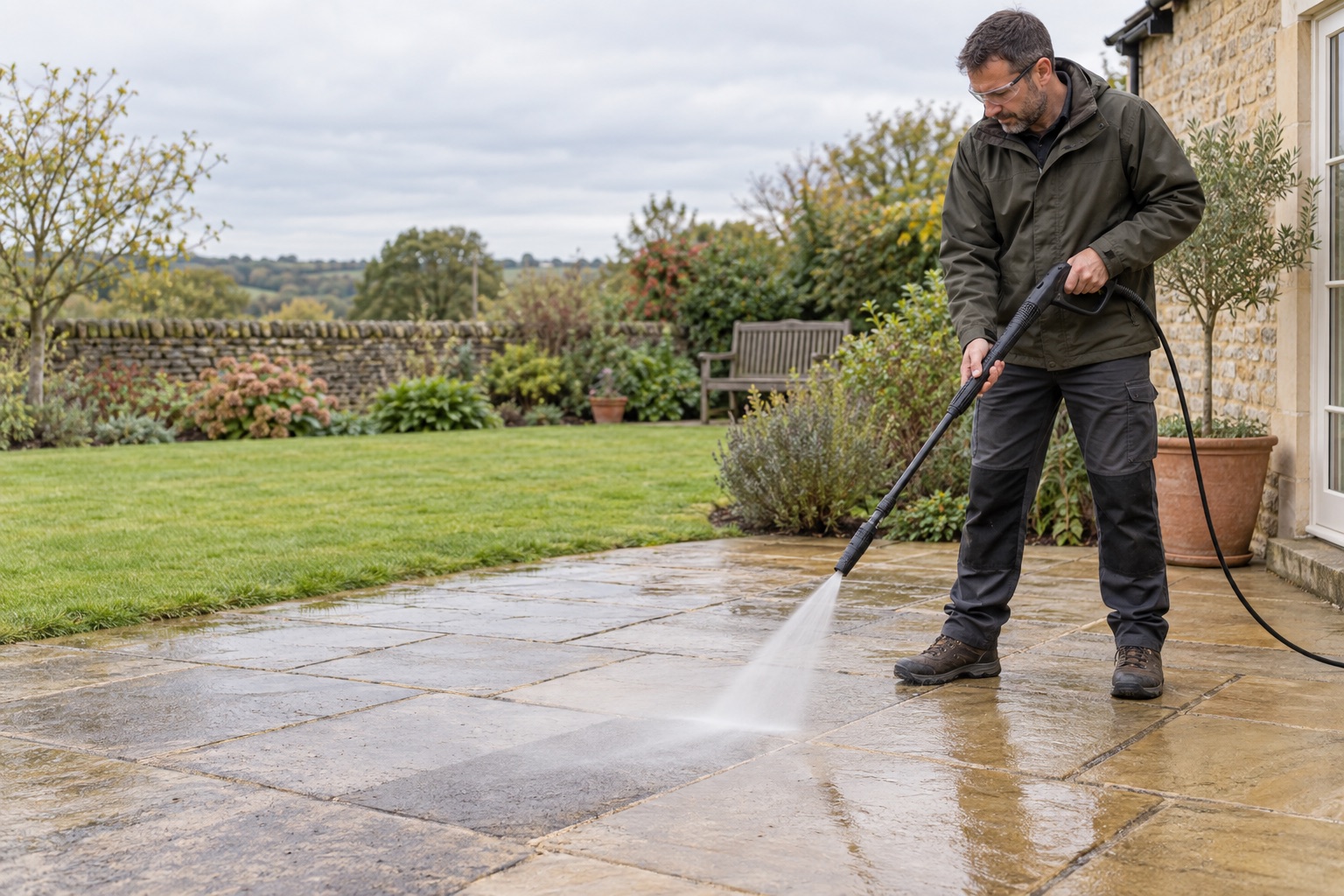
- Connect and inspect. Check the machine, hose, gun and couplings for damage. Keep plugs and extension connections dry and off wet ground.
- Choose the gentlest useful setup. Fit a broad fan or variable lance, select low pressure and leave the rotary nozzle aside.
- Test one discreet slab. Hold the lance well back, start the machine while pointing away from people and make a short pass.
- Work in sections. Use smooth overlapping strokes so no strip receives repeated concentrated impact. Move diagonally across pointing rather than following a joint.
- Rinse downhill or towards a safe collection point. Keep loosened grit moving without flooding beds, walls or thresholds.
- Let the test area dry. Wet stone can hide etching, colour change and uneven stripes. Inspect again before increasing force.
Wear eye protection and footwear with dependable grip. Keep children and pets away from both the working area and the hose route. Never direct the jet towards skin, people, animals, the machine or live electrical equipment, and do not work from a ladder.
Adjust the method to the paving
Concrete paving
Sound concrete usually tolerates a controlled fan, but weathered faces and decorative coatings can mark. Treat chipped edges and shallow joints as weak points. Read our detailed concrete slab cleaning guide.
Sandstone and limestone
Natural stone can vary from slab to slab. Avoid acidic cleaners, begin more gently than you would on concrete and stop if the face roughens or fresh colour is exposed unevenly. See the separate guides to sandstone and limestone.
Porcelain
Porcelain has low water absorption and routine dirt often releases with warm water and detergent. The pointing, edges and any installed finish still need protection. Our porcelain cleaning guide explains when pressure is unnecessary.
Useful control
Choose a washer you can turn down
The Kärcher K 4 Power Control Flex has adjustable 20–130 bar output and an eight-metre flexible hose, making it a balanced fit for mixed domestic patios. The Bosch UniversalAquatak 135 offers stronger 450 l/h maximum flow in a compact format, while the Nilfisk Core 140 centres pressure adjustment. None makes unsuitable paving safe: surface condition remains the limit.
 View product on Amazon
Kärcher K 4 Power Control Flex
Best for: Mixed household cleaning where control and an 8 m flexible hose matter
A balanced mains machine for patios, cars and general outdoor work. Its useful advantage is not extreme pressure but adjustable output, a flexible 8 m hose and a stable mid-range flow rate.
What stands out
- 20–130 bar adjustment
- 8 m PremiumFlex hose
- 420 l/h maximum flow
Keep in mind
- The base package does not include a surface cleaner
- At 12.1 kg before accessories it is not the lightest option
- 20–130 bar
- 420 l/h
- 8 m hose
- Mains · 1.8 kW
 View product on Amazon
Bosch UniversalAquatak 135
Best for: Smaller homes wanting one compact machine with a multi-pattern nozzle
A compact 135-bar washer with a strong 450 l/h maximum flow and a practical three-in-one nozzle. It reduces attachment swapping for routine car, furniture and small-patio jobs.
What stands out
- 450 l/h maximum flow
- Three spray patterns in one nozzle
- 7.9 kg machine weight
Keep in mind
- No surface cleaner in the standard box
- The 7 m PVC hose is shorter and less flexible than some rivals
- 135 bar max
- 450 l/h
- 7 m hose
- Mains · 1.9 kW
 View product on Amazon
Nilfisk Core 140 PowerControl
Best for: Users who value in-hand adjustment and a lighter trolley format
A light trolley-format washer with power adjustment for mixed-garden jobs. The current Amazon page conflicts on supplied hose length, so confirm the exact bundle before buying it for reach.
What stands out
- Power adjustment
- Compact trolley format
- Useful mid-range output
Keep in mind
- Bundles differ between retailers
- A surface cleaner may still be an extra purchase
- 140 bar max
- 40 m²/h listed
- Confirm hose length
- Mains · 1.8 kW
Compare the full shortlist in best pressure washers for patios and see when an enclosed head helps in our surface-cleaner guide.
Inspect the patio after it dries
Rinse residue, flush the washer with clean water as its manual directs and drain it before storage. Once the paving is dry, check pointing and jointing material across the whole area. Replace only with the correct material for the installation; ordinary mortar, resin jointing compound and block-paving sand are not interchangeable.
New streaks, exposed aggregate or a roughened stone face indicate that the process was too aggressive. Record the nozzle and setting that worked so the next maintenance clean can begin below that limit.
Manufacturer and safety guidance
Marshalls recommends regular sweeping, testing cleaners and keeping pressure no higher than medium for its paving guidance. Kärcher’s safety instructions also require stable footing, equipment checks and keeping the jet away from people, animals and electrical equipment.
Frequently asked questions
What pressure should I use on a patio?
There is no universal number. Begin at the machine’s low setting with a broad fan and generous distance, then let a dry test patch show whether more force is appropriate.
Can I pressure wash patio pointing?
Do not intentionally wash the joints. Cross them diagonally, reduce pressure near edges and stop if mortar or jointing material moves. Read how to protect patio pointing.
Should I use a surface cleaner or lance?
A compatible surface head can produce more even results on flat, sound paving. A lance gives better visibility around edges, steps and fragile joints. Both can cause damage if the setting is too strong.
Can I pressure wash a patio without detergent?
Often, yes. Sweep first and try water alone. For algae, lichen or staining, use only a treatment labelled for the exact material and follow all runoff and dwell-time instructions.
How long should a patio dry after washing?
Allow it to dry fully before judging colour, checking for damage or replacing joint material. Conditions vary with shade, temperature, drainage and slab porosity.