
Sandstone care guide
How to clean sandstone paving
Clean Indian sandstone and other sandstone paving without acids, harsh jetting or avoidable colour damage, with methods for dirt, algae and black spot.
Useful products for the job
Treat organic growth before considering pressure
Check your exact sandstone and sealer against the treatment label and test a hidden patch before applying it.
 View product on Amazon
Wet & Forget Outdoor Cleaner 5L
Best for: Label-approved outdoor surfaces with algae, mould or lichen
A concentrated outdoor treatment for organic growth on many exterior surfaces. It is a treatment, not an instant pressure-washing substitute; follow the label for dilution, weather and runoff.
Check the exact surface and any sealer with the maker before use; keep it out of ponds and follow plant and pet precautions.
- 5 l concentrate
- Outdoor surfaces
- Organic growth
- Label-led dilution
Material first
Sandstone is varied, porous and easy to treat too aggressively
Indian sandstone commonly contains natural colour and mineral variation. One slab may be denser than its neighbour, and riven faces hold dirt differently from smoother calibrated paving. Confirm the supplier and finish where possible, then check its maintenance guidance before choosing a cleaner or sealer.
Look for flaking, sandy patches, rust-like marks, loose pointing and previous coatings. These change the job. An inconspicuous test patch is essential because wet sandstone darkens and can conceal both stains and fresh damage.
| Condition | Preferred approach | Main risk | Check |
|---|---|---|---|
| Loose dirt | Dry sweeping | Grit scratching the face | Use a clean broad broom |
| General grime | Warm soapy water and brush | Cleaner drying on slabs | Work in small sections |
| Green growth | Stone-compatible labelled treatment | Plant and drain contamination | Follow every label control |
| Black lichen spots | Specialist sandstone-safe treatment | Uneven bleaching or etching | Test and allow realistic dwell time |
| Sound stone and joints | Low-pressure broad fan if permitted | Face erosion and lost pointing | Stop at the first surface change |
A safe routine sandstone-cleaning method
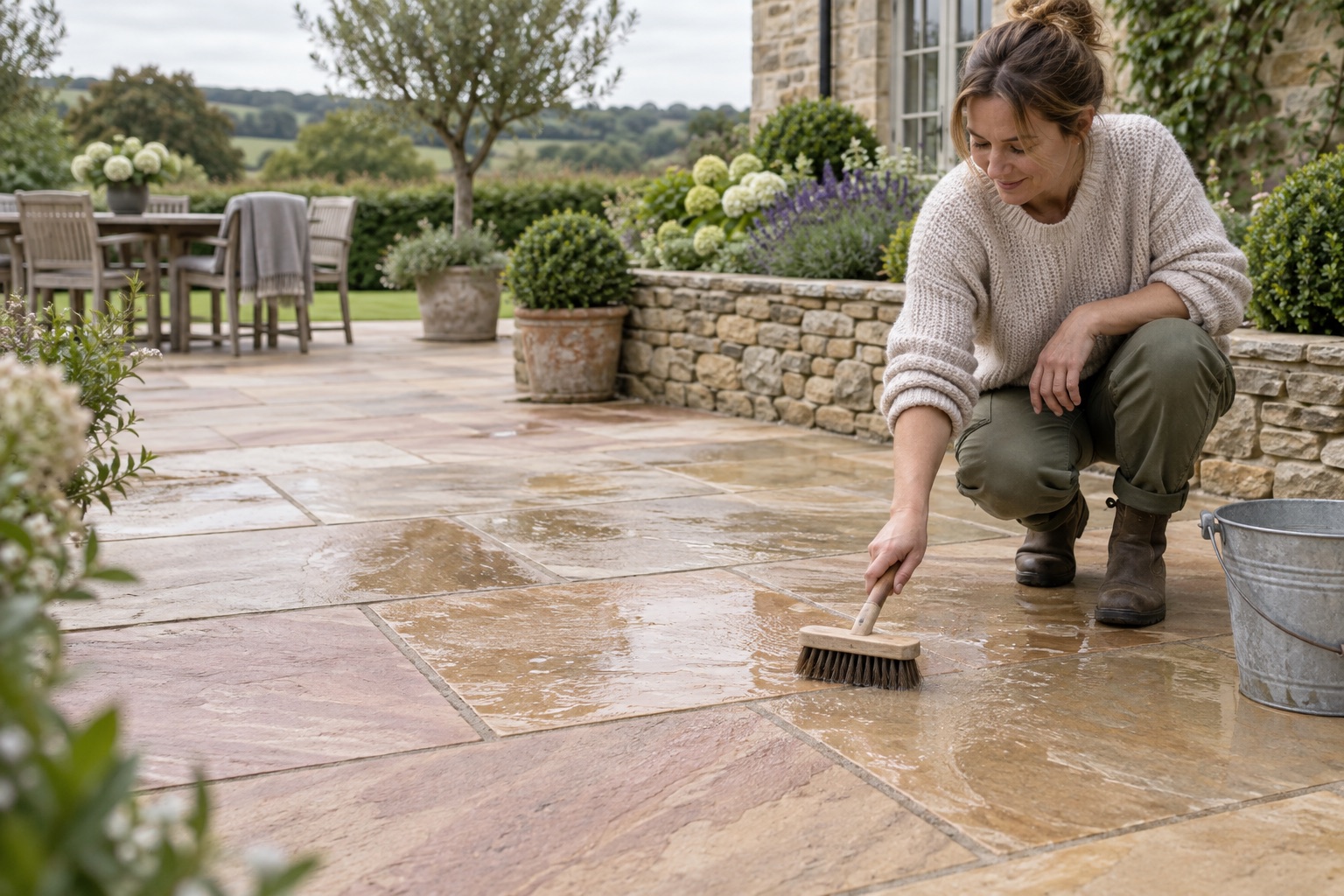
- Sweep loose grit, soil and leaves while the paving is dry.
- Wet a discreet section with clean water.
- Apply warm water with a mild, acid-free detergent permitted by the stone supplier.
- Brush with moderate pressure, following the surface texture without digging into joints.
- Rinse completely before the solution dries, then allow the stone to dry before judging it.
Do not use brick acid, hydrochloric acid or an acidic household descaler. Acid can react with minerals in sandstone and may create permanent rust-like discolouration as well as damage.
Treat the stain, not the entire patio by default
Algae and moss
Brush off loose material and correct leaf build-up or persistent shade where practical. If treatment is required, select a product labelled for natural sandstone and manage runoff. See the patio algae guide.
Black spots
Lichen colonies sit within the texture and may fade gradually rather than vanish in one pass. Use a compatible specialist product exactly as labelled, beginning with a test patch. Our black spot guide sets realistic expectations.
Rust, oil and unknown marks
Do not experiment with increasingly strong chemicals. Record the stain, stone and any previous treatment, then ask the paving supplier or a stone-care specialist for a compatible product.
Controlled machine option
If pressure washing is permitted, control matters more than maximum bar
The Kärcher K 4 offers adjustable output and an eight-metre flexible hose; the compact AVA Go P40 has lower maximum pressure with the same useful hose reach. Both should begin with a broad fan and generous distance. Move diagonally across joints, keep the lance moving and never use a rotary nozzle as the default on sandstone.
 View product on Amazon
Kärcher K 4 Power Control Flex
Best for: Mixed household cleaning where control and an 8 m flexible hose matter
A balanced mains machine for patios, cars and general outdoor work. Its useful advantage is not extreme pressure but adjustable output, a flexible 8 m hose and a stable mid-range flow rate.
What stands out
- 20–130 bar adjustment
- 8 m PremiumFlex hose
- 420 l/h maximum flow
Keep in mind
- The base package does not include a surface cleaner
- At 12.1 kg before accessories it is not the lightest option
- 20–130 bar
- 420 l/h
- 8 m hose
- Mains · 1.8 kW
 View product on Amazon
AVA Go P40 Medium
Best for: Cars, bikes and smaller outdoor areas where storage space is tight
A genuinely compact 120-bar mains washer with an 8 m flexible hose and 390 l/h flow. The small body and stored accessories make it appealing for sheds, garages and mobile car-care setups.
What stands out
- Compact body with stored accessories
- 8 m flexible hose
- Ten-year warranty when registered under AVA's terms
Keep in mind
- No surface cleaner in the Medium bundle
- Lower flow than the mid-range corded leaders here
- 120 bar max
- 390 l/h
- 8 m hose
- Mains · 1.7 kW
Follow the full safe pressure-washing sequence or compare all patio pressure-washer choices.
Keep sandstone cleaner with low-impact maintenance
Sweep before damp leaves decompose, clear soil from slab edges and move containers periodically. Check that water drains away rather than collecting in shaded pockets. If considering a sealer, choose one designed for the exact sandstone and understand that it can alter colour, sheen and future maintenance.
Frequently asked questions
Can I pressure wash Indian sandstone?
Only if the supplier permits it and the surface and joints are sound. Start with a low-pressure broad fan at generous distance and stop if the stone face changes.
Can I use bleach on sandstone paving?
Do not improvise bleach solutions. Use a product specifically labelled for the stone and problem, following its dilution, contact time and environmental controls.
Why has my sandstone turned orange?
Iron-bearing minerals can produce rust-like marks, sometimes after unsuitable chemical treatment. Stop experimenting and seek stone-specific advice.
Does sandstone need sealing after cleaning?
Not automatically. A sealer must suit the sandstone and desired finish, and it can change appearance. The paving supplier’s specification should decide.
How do I clean sandstone pointing?
Brush gently across sound joints and rinse without directing force into them. Repair cracked or missing pointing before any machine clean.