Skip to content

Topic guide

Pressure washers

Choose corded, cordless, compact and portable cleaning equipment by flow, reach, control and the jobs you actually need to do.

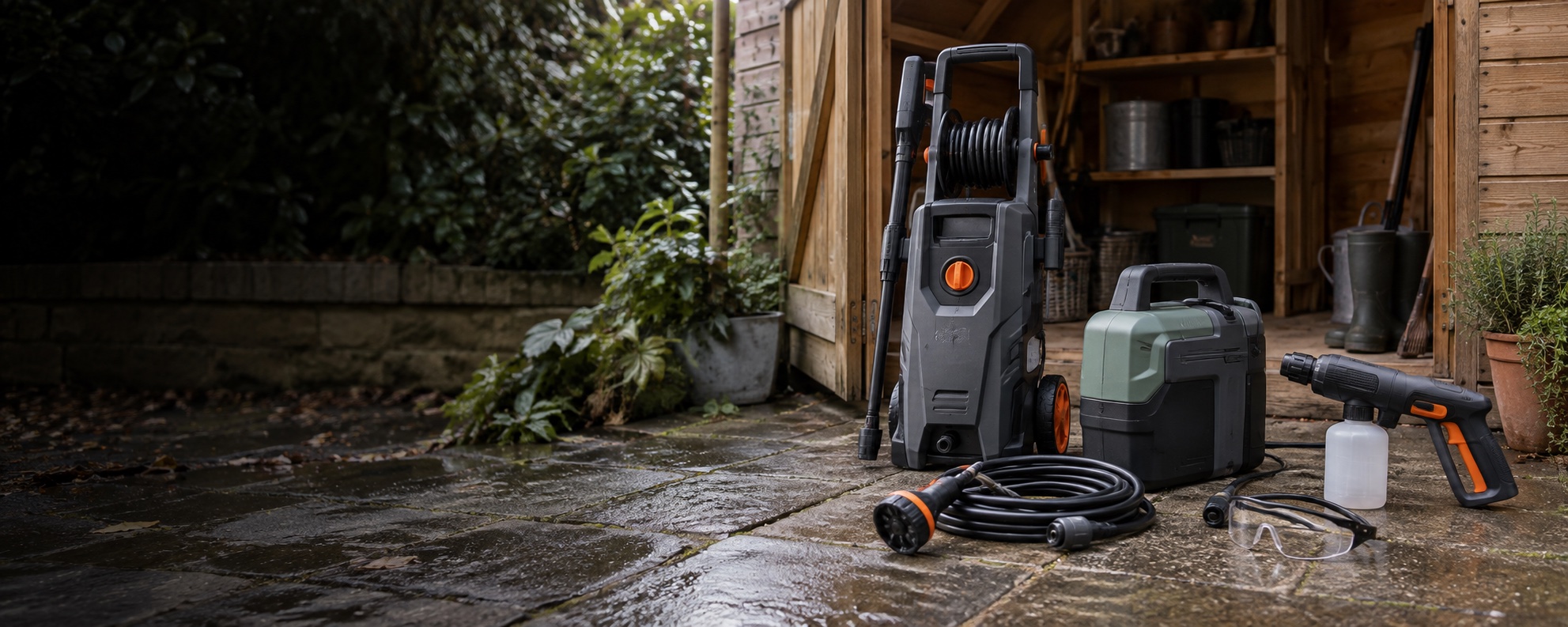
Three unbranded outdoor-cleaning formats arranged beside a British garden shed.

Corded machines: the household default

A mains pressure washer is still the clearest choice for patios, driveways and mixed cleaning around a typical UK home. It can sustain more flow than a handheld battery cleaner and does not impose a short runtime. The trade-off is a three-part tether: power cable, garden hose and high-pressure hose.

For most households, the useful middle of the range is not defined by one bar figure. Look for adjustable output, enough flow to rinse lifted dirt, a high-pressure hose that reaches around the working area and access to the attachment you will actually use.

Cordless is two different categories

A handheld power cleaner is light, portable and often able to draw from a bucket. It suits muddy bicycles, garden furniture and quick rinses. A self-contained cordless cleaner adds its own tank and wheels, but still trades the speed and flow of a mains machine for access.

Do not compare either type with a mains machine on maximum pressure alone. Water source, battery-included status, runtime, hose length and weight in the hand change the experience more.

Read specifications in this order

  1. Pressure control: can the output be reduced deliberately rather than controlled only by standing further away?
  2. Flow rate: litres per hour indicate how quickly loosened dirt can be moved away.
  3. Hose length and behaviour: reach is useful only if the hose does not fight every change of direction.
  4. Included equipment: check the exact bundle. A “Home” or “Car” suffix often changes the attachments, not the pump.
  5. Storage and support: measure the actual space and consider replacement hoses, connectors and service options.

Use the maker's page and manual for the exact model and bundle: Kärcher's K 4 Power Control Flex specification shows how pressure, flow and supplied equipment are listed separately.

More pressure is not an upgrade for every job

Timber, old mortar, unstable coatings, vehicle seals and many rendered surfaces need restraint. If a job depends on holding a powerful rotary jet close to the surface, the method is probably wrong. Begin with the surface maker's guidance, use a broad fan and the lowest effective setting, and stop if the material changes.

Buying guides for the details that change daily use

For car care, compare control, foam compatibility and hose reach. Timber owners should begin with the decking-specific shortlist. If the machine cannot stay close to the work, see long-hose pressure washers; where neighbours are close, use the lower-disruption guide.

For homes without convenient connections, begin with cordless cleaners, portable formats or the practical guide to cleaning without an outside tap.

Keep the washer working safely

A machine that pulses or surges, will not start, keeps cutting out or leaks water needs a different first check. Start with the symptom and stop when the fault moves beyond accessible, user-serviceable parts.

Routine care includes cleaning the nozzle and inlet filter, frost-free winter storage and keeping electrical connections safe outdoors.

Useful examples

Different formats for different jobs

These products illustrate the equipment types described above. Match the format to the surface, water source and working area.

Best all-rounder Kärcher K 4 Power Control Flex pressure washer

Kärcher K 4 Power Control Flex

Best for: Mixed household cleaning where control and an 8 m flexible hose matter

A balanced mains machine for patios, cars and general outdoor work. Its useful advantage is not extreme pressure but adjustable output, a flexible 8 m hose and a stable mid-range flow rate.

What stands out

  • 20–130 bar adjustment
  • 8 m PremiumFlex hose
  • 420 l/h maximum flow

Keep in mind

  • The base package does not include a surface cleaner
  • At 12.1 kg before accessories it is not the lightest option
  • 20–130 bar
  • 420 l/h
  • 8 m hose
  • Mains · 1.8 kW
Best self-contained cleaner Bosch Fontus 18V cordless outdoor cleaner

Bosch Fontus 18V

Best for: Cars, bikes and furniture where a tap or socket is inconvenient

A wheeled cordless outdoor cleaner with a 15-litre built-in tank, adjustable output and four spray patterns. Its 20-bar pressure suits controlled rinsing rather than large-patio restoration.

What stands out

  • 15-litre built-in water tank
  • Four spray patterns
  • Up to 60 minutes quoted with the recommended battery

Keep in mind

  • The selected Amazon listing excludes battery and charger
  • 20 bar is not intended for heavy paved-area cleaning
  • 20 bar max
  • 15 l tank
  • 4 m hose
  • 18 V battery
Best handheld rinse tool Worx Nitro HydroShot WG633E portable power cleaner

Worx Nitro HydroShot WG633E

Best for: Bikes, garden furniture and quick rinses where portability matters most

A lightweight handheld cleaner rather than a substitute for a mains patio machine. It draws from a bucket or other fresh-water source and delivers 38-bar rated pressure with up to 220 l/h flow.

What stands out

  • 2.2 kg with battery
  • Draws from a separate water source
  • Five spray patterns and 6 m suction hose

Keep in mind

  • Far lower pressure and flow than a mains washer
  • A poor fit for large or heavily soiled paving
  • 38 bar rated
  • 56 bar max
  • 220 l/h max
  • 20 V battery