
Patio buying guide
Best pressure washers for patios
Compare pressure washers for UK patios by water flow, control, hose reach and surface-cleaner compatibility, with advice for different paving materials.
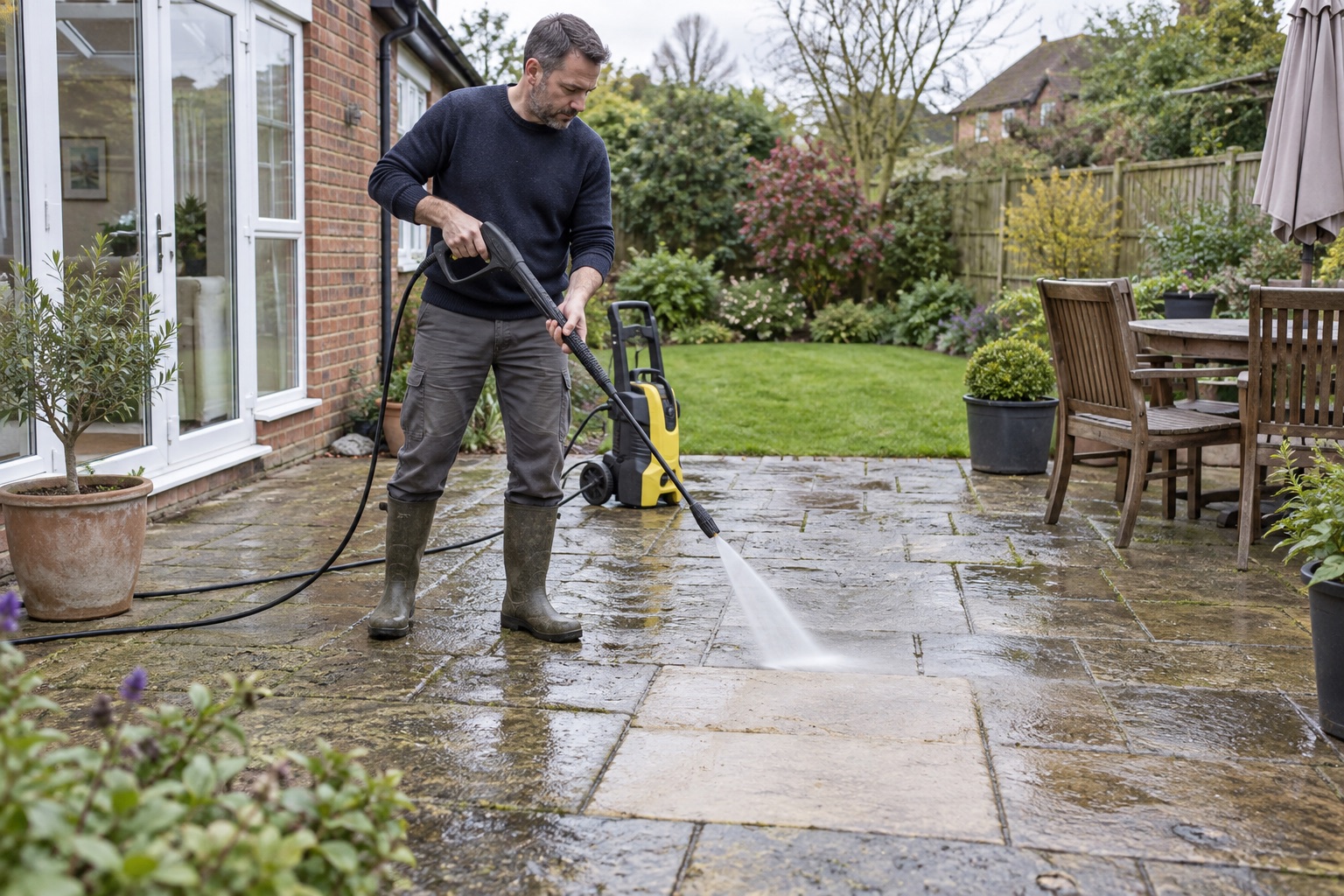
Bosch specifies a seven-metre hose, 135 bar maximum pressure and 7.5 litres per minute maximum flow for the UniversalAquatak 135; those are machine figures, not a promise of cleaning speed. See Bosch's technical data.
The useful shortlist
Choose for the patio you actually have
A patio washer needs enough flow to carry loosened dirt away, a hose that reaches the working area and control for joints, edges and less robust slabs. Maximum pressure alone is a poor shortcut. A forceful rotary jet can make fast progress on sound concrete and still be the wrong tool for soft sandstone, loose pointing or a coated surface.
For a mixed garden, the Kärcher K 4 Power Control Flex is the most balanced option here. The Bosch UniversalAquatak 135 trades an integrated hose reel for a compact body and strong 450 l/h maximum flow. The Nilfisk Core 140 gives visible adjustment in a light trolley format. The AVA Go P40 is the storage-led choice for smaller paved areas.
 View product on Amazon
Kärcher K 4 Power Control Flex
Best for: Mixed household cleaning where control and an 8 m flexible hose matter
A balanced mains machine for patios, cars and general outdoor work. Its useful advantage is not extreme pressure but adjustable output, a flexible 8 m hose and a stable mid-range flow rate.
What stands out
- 20–130 bar adjustment
- 8 m PremiumFlex hose
- 420 l/h maximum flow
Keep in mind
- The base package does not include a surface cleaner
- At 12.1 kg before accessories it is not the lightest option
- 20–130 bar
- 420 l/h
- 8 m hose
- Mains · 1.8 kW
 View product on Amazon
Bosch UniversalAquatak 135
Best for: Smaller homes wanting one compact machine with a multi-pattern nozzle
A compact 135-bar washer with a strong 450 l/h maximum flow and a practical three-in-one nozzle. It reduces attachment swapping for routine car, furniture and small-patio jobs.
What stands out
- 450 l/h maximum flow
- Three spray patterns in one nozzle
- 7.9 kg machine weight
Keep in mind
- No surface cleaner in the standard box
- The 7 m PVC hose is shorter and less flexible than some rivals
- 135 bar max
- 450 l/h
- 7 m hose
- Mains · 1.9 kW
Best for control and compact storage
The Nilfisk and AVA solve different frustrations. Nilfisk puts adjustment at the centre of the setup, which is useful when moving from open slabs to edges and furniture. AVA packages an eight-metre flexible hose into a much smaller body. Its lower 390 l/h flow is a fair trade on a modest patio, but it becomes more noticeable when rinsing a large area.
 View product on Amazon
Nilfisk Core 140 PowerControl
Best for: Users who value in-hand adjustment and a lighter trolley format
A light trolley-format washer with power adjustment for mixed-garden jobs. The current Amazon page conflicts on supplied hose length, so confirm the exact bundle before buying it for reach.
What stands out
- Power adjustment
- Compact trolley format
- Useful mid-range output
Keep in mind
- Bundles differ between retailers
- A surface cleaner may still be an extra purchase
- 140 bar max
- 40 m²/h listed
- Confirm hose length
- Mains · 1.8 kW
 View product on Amazon
AVA Go P40 Medium
Best for: Cars, bikes and smaller outdoor areas where storage space is tight
A genuinely compact 120-bar mains washer with an 8 m flexible hose and 390 l/h flow. The small body and stored accessories make it appealing for sheds, garages and mobile car-care setups.
What stands out
- Compact body with stored accessories
- 8 m flexible hose
- Ten-year warranty when registered under AVA's terms
Keep in mind
- No surface cleaner in the Medium bundle
- Lower flow than the mid-range corded leaders here
- 120 bar max
- 390 l/h
- 8 m hose
- Mains · 1.7 kW
Side by side
Patio-cleaning specifications
| Model | Pressure | Flow | Hose | Best patio fit | Main compromise |
|---|---|---|---|---|---|
| Kärcher K 4 Power Control Flex | 20–130 bar | 420 l/h | 8 m | Mixed medium patios | Surface head costs extra |
| Bosch UniversalAquatak 135 | 135 bar max | 450 l/h | 7 m | Small-to-medium robust paving | Standard box has no surface head |
| Nilfisk Core 140 PowerControl | 140 bar max | 465 l/h max | Confirm bundle hose | Buyers wanting adjustable output | Amazon bundles vary |
| AVA Go P40 Medium | 120 bar max | 390 l/h | 8 m | Small patios and tight storage | Slower on broad neglected paving |
Match the washer to the paving
Concrete slabs and sound block paving
These commonly suit a mid-range mains machine, but condition matters more than the material name. Check for cracked slabs, loose mortar and missing jointing sand first. Work with a broad fan, begin below maximum and treat a rotary nozzle as a local tool rather than the default.
Sandstone and limestone
Natural stone varies in density and finish. Aggressive pressure can roughen softer faces, expose fresh colour unevenly or erode joints. Read the paving supplier's care instructions and test a hidden area. The ability to reduce pressure is more valuable than a high maximum figure.
Porcelain and sealed paving
Porcelain itself is hard, but grout, pointing, sealant and nearby edges remain vulnerable. On sealed paving, confirm that pressure washing is permitted for the exact coating. A surface cleaner can improve consistency on flat slabs, but it does not make a weak joint safe.
What matters when buying for a patio
- Flow rate: for broad areas, water movement helps clear the dirt that pressure has released.
- Useful control: a variable lance or dependable adjustment makes edges and mixed materials easier to manage.
- Hose reach: measure from the machine's likely position, around furniture, steps and corners.
- Surface-cleaner compatibility: check the exact connector and model family, not only the brand name.
- Storage and setup: a machine that is easy to retrieve, connect and drain is more likely to receive sensible maintenance.
For a deeper overview of pressure, flow and machine formats, read how to choose a pressure washer. If the garden includes several jobs, compare the broader best pressure washers for UK homes.
Is a patio-cleaner attachment worth having?
An enclosed surface head keeps two rotating jets at a more consistent distance and contains much of the splash. That can make suitable flat paving quicker and tidier. Head width should be proportionate to the machine's flow: a very wide head on a modest washer can feel slow, while an aggressive setting can still remove jointing material.
Manufacturer bundle names change, and a “Home” package may include a surface head while the base machine does not. Compare the exact model number and box contents on Amazon. Our separate guide to pressure washers with surface-cleaner options explains the choice in more detail.
Plan the clean before connecting the hose
Move pots and furniture, sweep grit, identify drains and protect doors, vents and electrical fittings. Keep dirty water containing detergent, oil or other contaminants away from surface-water drains. Wear eye protection and stable footwear, keep electrical connections dry and protected, and never use a pressure-washer lance from a ladder.
Frequently asked questions
What pressure washer is best for a medium patio?
A controllable mid-range mains machine with roughly 400–465 l/h flow and at least seven metres of hose is a practical starting point. The paving type, joints and condition still decide the safe nozzle and setting.
Is 120 bar enough to clean a patio?
It can be enough for a small area of sound paving, particularly when the machine has useful flow and the dirt is not deeply established. It is not a promise of fast results on every surface.
Should I use a turbo nozzle on patio slabs?
Only where the machine and paving guidance allow it. A rotary jet concentrates impact and can mark softer stone or remove joint material. Start with a broad fan and reserve stronger tools for small, sound areas.
Will pressure washing remove patio pointing?
It can remove loose, cracked or shallow pointing. Inspect the joints first, avoid directing the jet into them and reduce pressure near edges.
Do I need detergent to clean a patio?
Not always. Sweep and rinse first. If treatment is needed, use a product labelled for the exact paving and follow its dilution, dwell-time, plant-protection and runoff instructions.