
Porcelain paving guide
How to clean porcelain paving
Keep outdoor porcelain paving clean with gentle washing, stain-specific treatment and careful joint protection, including when pressure washing is appropriate.
Low absorption, simple care
Clean porcelain before reaching for high pressure
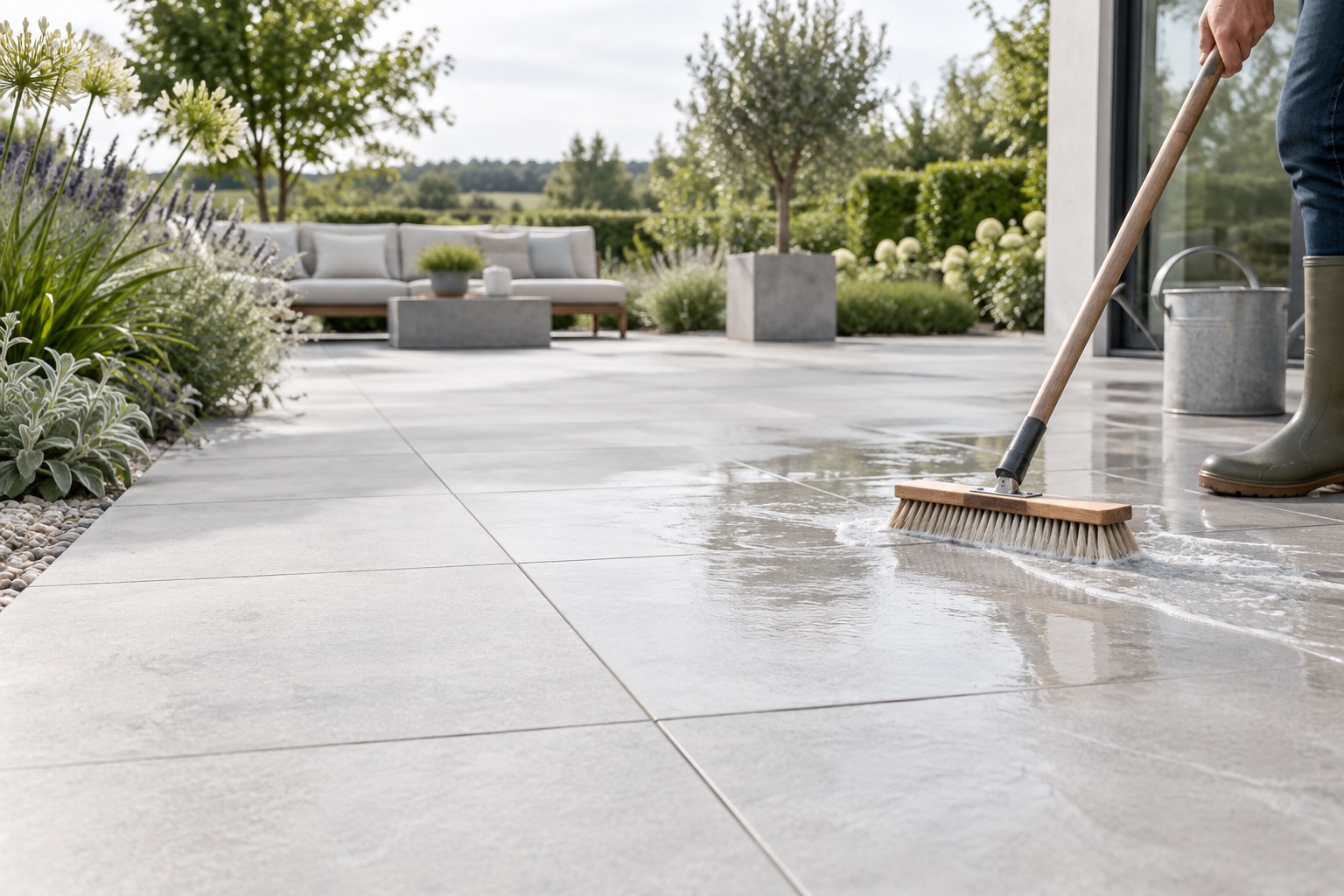
Outdoor porcelain is dense and resistant to water absorption, but its textured surface can hold fine soil. Sweep carefully, particularly around furniture feet and planters. Work in small sections with warm water and a mild detergent approved for external porcelain, agitate with a soft or medium brush and rinse before the wash dries.
The surface may be robust while the grout or jointing is not. Check for cracks, open edges and loose residue before cleaning. Dark grout lines are not automatically dirt: changing their colour aggressively can produce a patchy result.
| Job | Best first step | Escalation | Protect |
|---|---|---|---|
| Dust and leaves | Dry sweep | Hose rinse | Tile edges and furniture feet |
| Everyday grime | Warm water and mild detergent | Repeat with soft-medium brush | Slip-resistant texture |
| Food or grease mark | Porcelain-compatible cleaner | Supplier-approved stain treatment | Nearby joints and drainage |
| Green film | Brush and material-safe treatment | Controlled low-pressure rinse | Plants and runoff |
| Installation residue | Installer or manufacturer guidance | Specialist porcelain product | Do not use unknown acids |
Match the product to the stain
Blot fresh spills instead of spreading them. Use a product specifically approved for porcelain for oil, food, rust-like marks or installation residue, and test it on a spare tile or inconspicuous corner. Do not use a strong acid simply because the tile itself is ceramic; joints, metals, nearby stone and landscaping can react differently.
For algae in shaded areas, remove surface growth with brushing and address standing water. Follow our algae removal guide if a labelled treatment is needed.
Pressure washing is optional, not routine
If brushing leaves stubborn residue and the installation guidance permits pressure washing, use a broad fan, low setting and generous distance. Bradstone’s porcelain guidance suggests a fan jet and approximately 30 cm distance for stubborn stains. Avoid directing the jet into joints or holding it over one spot.
An enclosed surface head can improve consistency on a flat installation, but it reduces visibility around weak joints and edges. Test with the gentlest setup first.
Compact controlled options
Useful washers for occasional porcelain rinsing
The Bosch UniversalAquatak 135 combines 450 l/h maximum flow with a compact body, while the AVA Go P40 is the storage-conscious option with an eight-metre hose. Use their broadest suitable spray and stay below the setting proved safe by a dry test patch.
 View product on Amazon
Bosch UniversalAquatak 135
Best for: Smaller homes wanting one compact machine with a multi-pattern nozzle
A compact 135-bar washer with a strong 450 l/h maximum flow and a practical three-in-one nozzle. It reduces attachment swapping for routine car, furniture and small-patio jobs.
What stands out
- 450 l/h maximum flow
- Three spray patterns in one nozzle
- 7.9 kg machine weight
Keep in mind
- No surface cleaner in the standard box
- The 7 m PVC hose is shorter and less flexible than some rivals
- 135 bar max
- 450 l/h
- 7 m hose
- Mains · 1.9 kW
 View product on Amazon
AVA Go P40 Medium
Best for: Cars, bikes and smaller outdoor areas where storage space is tight
A genuinely compact 120-bar mains washer with an 8 m flexible hose and 390 l/h flow. The small body and stored accessories make it appealing for sheds, garages and mobile car-care setups.
What stands out
- Compact body with stored accessories
- 8 m flexible hose
- Ten-year warranty when registered under AVA's terms
Keep in mind
- No surface cleaner in the Medium bundle
- Lower flow than the mid-range corded leaders here
- 120 bar max
- 390 l/h
- 8 m hose
- Mains · 1.7 kW
Compare patio washers or use the complete safe patio washing method.
Avoid these porcelain patio mistakes
- Using abrasive wire brushes that can leave metal marks or alter the surface.
- Allowing dirty detergent solution to dry back onto textured tiles.
- Assuming every grout or jointing compound tolerates the tile cleaner.
- Applying sealer without the tile maker’s instruction; outdoor porcelain normally does not need routine sealing.
- Judging slip resistance while soap residue remains.
Frequently asked questions
Can I use a pressure washer on porcelain paving?
Usually only as a controlled option if the tile and jointing guidance permits it. Use a fan jet, low setting and sensible distance, and never target the joints.
What is the best cleaner for outdoor porcelain?
For routine dirt, warm water and a mild detergent approved for porcelain. For a specific stain, use a labelled porcelain product rather than a stronger general chemical.
Why does my porcelain patio look streaky?
Detergent or dirty rinse water may have dried on the textured surface. Rewash a small area with clean water and rinse in manageable sections.
Does porcelain paving need sealing?
Most outdoor porcelain does not. Confirm with the tile manufacturer and installer, particularly where grout or a specialist surface treatment is involved.
How do I clean porcelain patio joints?
Use a compatible brush and cleaner without digging into the joint. If material is cracked or loose, repair it before machine cleaning.