
Decking buying guide
Best pressure washers for decking
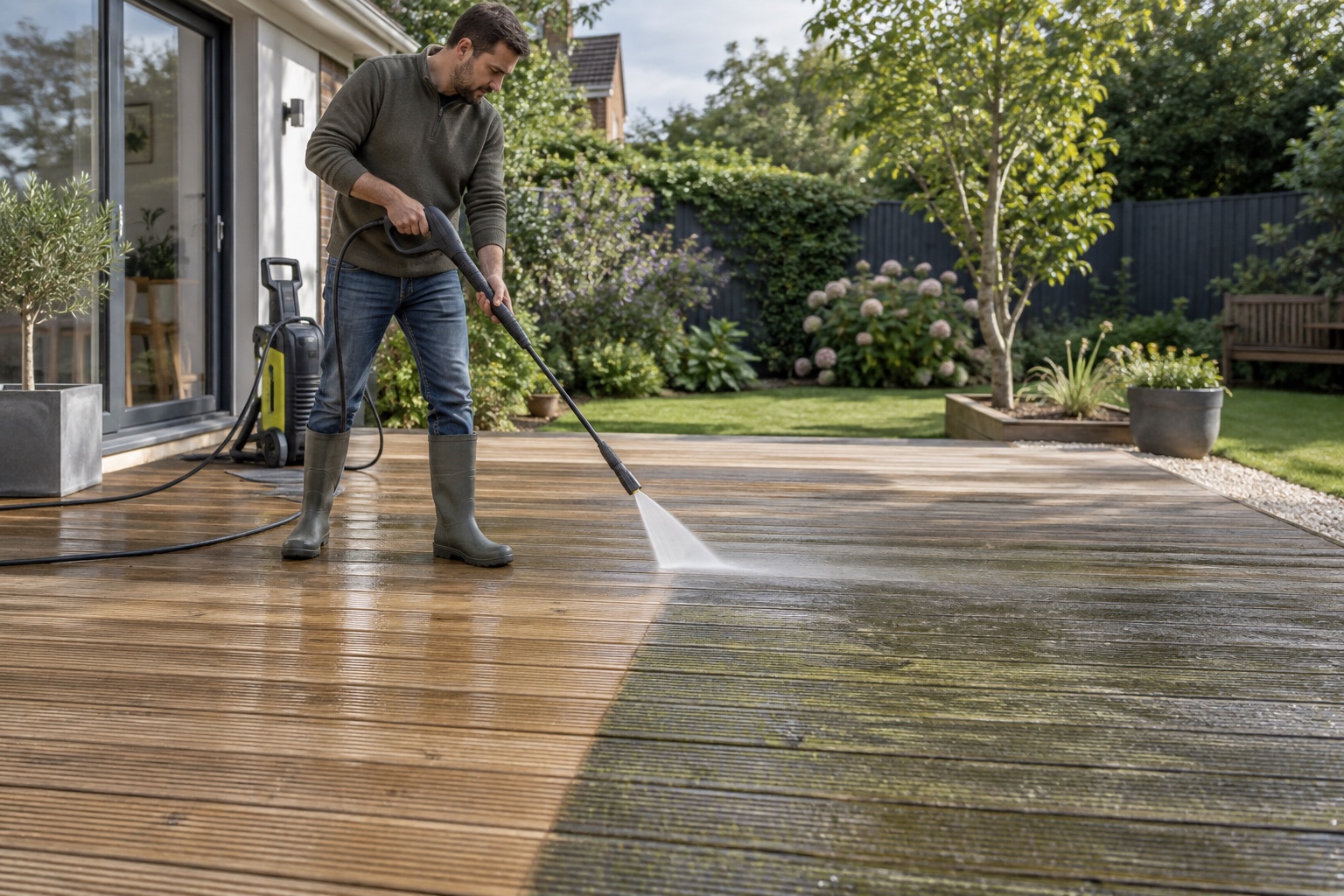
Compare controllable pressure washers for timber and composite decking, with practical advice on nozzles, flow, hose reach and safer alternatives.
Useful products for the job
A deck-safe cleaning method comes before the machine
Ronseal cleaner is for timber decking; composite boards need their manufacturer's approved detergent and brush method.
 View product on Amazon
Ronseal Decking Cleaner 5L
Best for: Cleaning and reviving timber boards before a compatible finish
A deck-specific cleaner for weathered hardwood and softwood. Scrub according to the label, rinse thoroughly and allow the boards to dry fully before oiling.
Use on timber decking after a patch test; check old coatings and the chosen finish instructions.
- 5 l
- Timber decking
- Scrub then rinse
- Patch test
 View product on Amazon
Unger Wood & Composite Deck Brush with Pole
Best for: Manual cleaning of wood and composite deck boards with a supplied telescopic pole
This bundle pairs the dual-bristle, swivelling deck brush with an adjustable telescopic pole. Gentler centre bristles clean board faces while firmer seam bristles reach gaps. Follow the board maker's cleaning guidance.
Check the composite manufacturer's approved brush guidance and test on an inconspicuous board.
- Dual-bristle head
- Swivelling brush
- Wood and composite
- Telescopic pole included
Kärcher lists a Vario Power spray lance for the K 4 Power Control Flex. Adjustment helps set up a cautious test, but it does not make high pressure safe for every deck. See Kärcher's supplied equipment.
Controlled mains machines
The safest useful feature is adjustment
Decking can be permanently roughened by a close, concentrated jet. The right machine is therefore one that makes lower-pressure, broad-fan work straightforward. The Kärcher K 4 combines a wide adjustment range with useful hose reach. The Nilfisk Core 140 also supports deliberate output control, but the linked Amazon page conflicts on hose length, so confirm working reach before buying.
 View product on Amazon
Kärcher K 4 Power Control Flex
Best for: Mixed household cleaning where control and an 8 m flexible hose matter
A balanced mains machine for patios, cars and general outdoor work. Its useful advantage is not extreme pressure but adjustable output, a flexible 8 m hose and a stable mid-range flow rate.
What stands out
- 20–130 bar adjustment
- 8 m PremiumFlex hose
- 420 l/h maximum flow
Keep in mind
- The base package does not include a surface cleaner
- At 12.1 kg before accessories it is not the lightest option
- 20–130 bar
- 420 l/h
- 8 m hose
- Mains · 1.8 kW
 View product on Amazon
Nilfisk Core 140 PowerControl
Best for: Users who value in-hand adjustment and a lighter trolley format
A light trolley-format washer with power adjustment for mixed-garden jobs. The current Amazon page conflicts on supplied hose length, so confirm the exact bundle before buying it for reach.
What stands out
- Power adjustment
- Compact trolley format
- Useful mid-range output
Keep in mind
- Bundles differ between retailers
- A surface cleaner may still be an extra purchase
- 140 bar max
- 40 m²/h listed
- Confirm hose length
- Mains · 1.8 kW
Compact mains choice for a smaller deck
The AVA Go P40 is easy to carry and store, with an eight-metre flexible hose that keeps the small body off the work area. Its 390 l/h flow is sufficient for measured cleaning and rinsing of a modest deck. Avoid interpreting its compactness as permission to work closer to the boards.
 View product on Amazon
AVA Go P40 Medium
Best for: Cars, bikes and smaller outdoor areas where storage space is tight
A genuinely compact 120-bar mains washer with an 8 m flexible hose and 390 l/h flow. The small body and stored accessories make it appealing for sheds, garages and mobile car-care setups.
What stands out
- Compact body with stored accessories
- 8 m flexible hose
- Ten-year warranty when registered under AVA's terms
Keep in mind
- No surface cleaner in the Medium bundle
- Lower flow than the mid-range corded leaders here
- 120 bar max
- 390 l/h
- 8 m hose
- Mains · 1.7 kW
Low-pressure maintenance where access is awkward
The Bosch Fontus is better understood as an outdoor cleaner. Its 20-bar maximum and built-in tank suit loose dirt, pollen and light green film where a hosepipe or socket is inconvenient. It will not replace a correctly selected decking cleaner, brush and thorough rinse on an established coating of grime.
 View product on Amazon
Bosch Fontus 18V
Best for: Cars, bikes and furniture where a tap or socket is inconvenient
A wheeled cordless outdoor cleaner with a 15-litre built-in tank, adjustable output and four spray patterns. Its 20-bar pressure suits controlled rinsing rather than large-patio restoration.
What stands out
- 15-litre built-in water tank
- Four spray patterns
- Up to 60 minutes quoted with the recommended battery
Keep in mind
- The selected Amazon listing excludes battery and charger
- 20 bar is not intended for heavy paved-area cleaning
- 20 bar max
- 15 l tank
- 4 m hose
- 18 V battery
Side by side
Deck-cleaning specifications
| Model | Pressure | Flow / water | Hose | Best use | Limitation |
|---|---|---|---|---|---|
| Kärcher K 4 Power Control Flex | 20–130 bar | 420 l/h | 8 m | Mixed timber and household work | Strong nozzles require restraint |
| Nilfisk Core 140 PowerControl | 140 bar max | 465 l/h max | Confirm bundle hose | Visible adjustment | Confirm hose reach |
| AVA Go P40 Medium | 120 bar max | 390 l/h | 8 m | Small decks and compact storage | Slower rinsing |
| Bosch Fontus 18V | 20 bar max | 15 l tank | 4 m | Gentle maintenance rinsing | Not for heavy restoration |
Timber and composite boards need different decisions
Softwood decking
Pressure-treated softwood can raise grain quickly when the jet is too close or concentrated. Inspect for rot, splits, protruding fixings and failing coatings. A brush and suitable cleaner may be the better first method.
Hardwood decking
Dense hardwood is not indestructible. Weathered fibres and old oil can still be stripped unevenly. Follow the board or treatment maker, test discreetly and clean along the grain.
Composite decking
Composite products differ in cap, texture and warranty conditions. Use the maker's cleaning instructions. Some permit low-pressure washing at a stated distance; others emphasise soap and a soft brush. Do not transfer advice from one brand to another.
Features and technique work together
- Broad fan pattern: spreads impact and reduces the chance of cutting a narrow line.
- Reliable adjustment: makes it easier to begin low and increase only if the board maker permits it.
- Flexible hose: helps maintain an even stance and direction along the boards.
- Appropriate detergent delivery: useful only with a cleaner labelled for the board and coating.
- Manageable machine weight: reduces the temptation to place a heavy trolley on vulnerable boards.
Keep the lance moving, work with the grain, overlap passes and stop if fibres begin to lift. Never use a rotary nozzle unless the exact decking guidance explicitly permits it. Our surface guide explains why material identification comes before pressure.
Cleaning before oiling or staining
A pressure washer does not shorten the drying time needed before treatment. Remove residues, rinse thoroughly and let the deck reach the moisture condition required by the finish manufacturer. Raised fibres may need appropriate preparation after drying. Applying oil over trapped moisture or cleaner residue can compromise the finish.
Frequently asked questions
Can you pressure wash timber decking?
Sometimes, if the timber is sound and its treatment guidance allows it. Use a broad fan, low pressure, generous distance and a test area. Stop if fibres lift.
What pressure washer setting should I use on decking?
There is no universal setting. Begin at the lowest effective output permitted by the board maker and adjust distance and fan width before increasing pressure.
Can I use a patio surface cleaner on decking?
Only if both the attachment and decking manufacturer specifically permit it. Many heads are intended for robust mineral surfaces and can be too aggressive for boards.
Why has my decking gone furry after pressure washing?
The jet has raised or torn surface fibres. Allow the timber to dry, assess the damage and follow the board or coating maker's preparation advice before refinishing.
Is it better to clean decking without a pressure washer?
Often yes, particularly on soft, weathered, coated or unknown boards. A suitable cleaner, soft or medium brush and controlled rinse provide more control.