
Nozzle buying and safety guide
Pressure-washer nozzle guide
Learn how pressure-washer nozzles change cleaning force, which patterns suit patios and cars, and how to check model-specific compatibility.
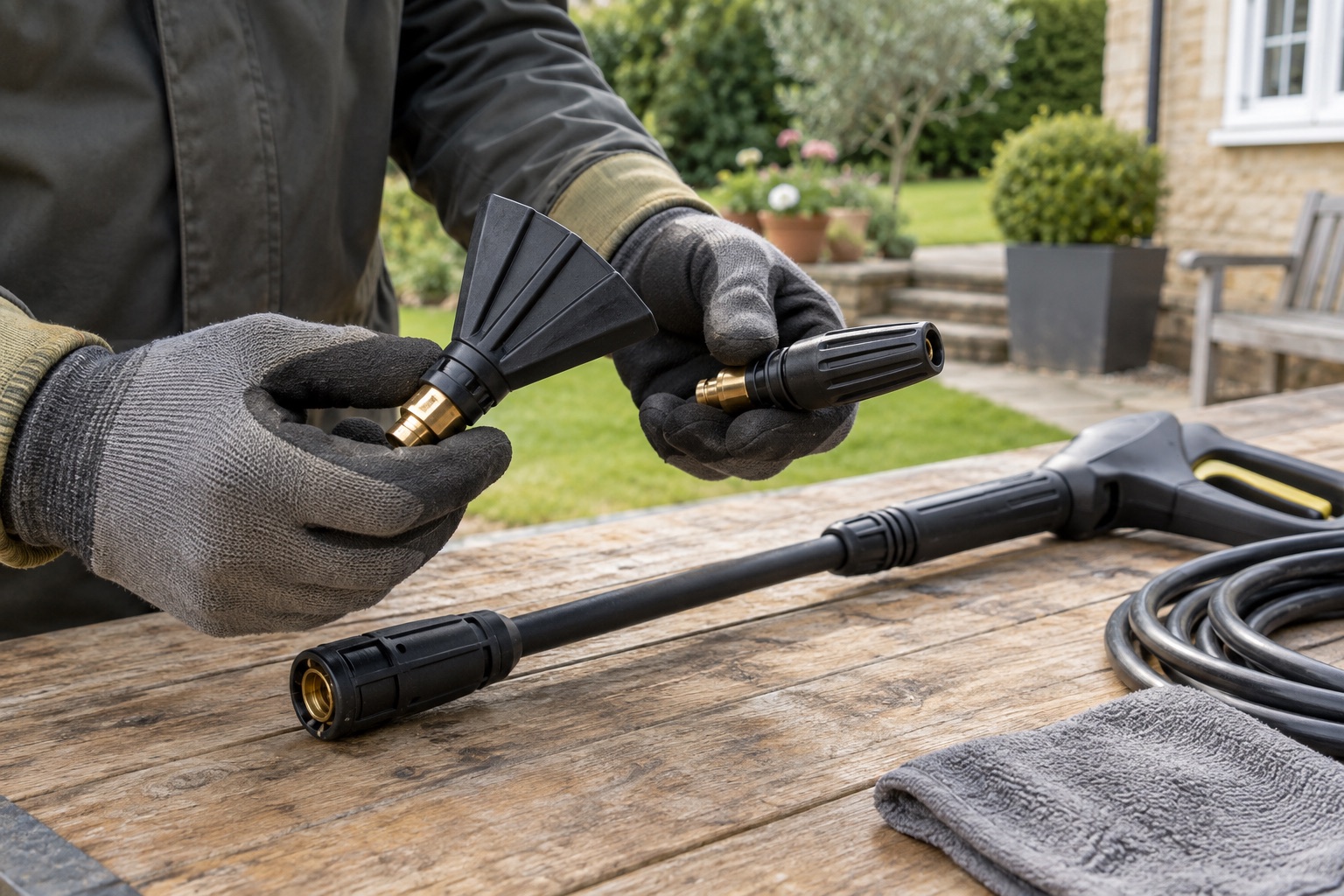
What the different nozzle patterns actually do
A broad fan distributes the water over a strip. It is the default starting point for most household cleaning because you can see the effect while controlling distance and angle. A rotary nozzle moves a narrow jet rapidly in a cone; it is fast on robust mineral dirt but can erode mortar, abrade timber and damage paint. A pencil jet concentrates force into one point and should not be a routine cleaning setting.
A detergent or foam nozzle serves a different job: it applies cleaning product at the machine's intended detergent pressure and flow. It is not a substitute for the final rinse. Some adjustable nozzles combine patterns in one housing, but changing the pattern does not make a delicate substrate pressure-proof.
Concept diagrams, not to scale. Blue shows the water path; the dark bar shows a surface. Shape does not establish safe pressure, distance or compatibility.
Broad fan
Distributes water across a strip. Where pressure is permitted, start gently and patch-check; a broad pattern is not a guarantee against damage.
Rotary / turbo
A concentrated jet sweeps a cone. It can abrade surfaces despite covering a wider area; keep it away from cars, fragile coatings, timber and weak joints.
Pencil / point
Concentrates force in a small spot. Not a routine household-cleaning starting point; changing distance does not make it suitable for a delicate surface.
Detergent / foam application
Applies an approved cleaner through the specified accessory or dosing circuit. Systems differ; follow the machine and label, then rinse only as required.
Match pattern to surface and task
On sound concrete, start with a fan and test a small patch; use a suitable surface-cleaner head for broad flat areas if the manufacturer permits it. For cars, use a broad fan and keep away from damaged trim, stone chips, seals, cameras and electrical details. Bosch expressly warns against rotary and pencil jets on motor vehicles. Timber and composite decking need the board maker's cleaning guidance first; a brush and cleaner may be safer than any high-pressure jet.
Distance, movement and angle often matter more than the number printed on a nozzle. Increase cleaning action gradually; never begin close to an unknown surface. See our rotary versus fan nozzle and car pressure and distance guides.
Scroll sideways on smaller screens. This selects a method, not a universal nozzle angle, bar setting or working distance.
| Surface / condition | Starting method | Exclude or pause | Detailed route |
|---|---|---|---|
| Sound concrete or block paving | Sweep; broad fan only if paving/pointing guidance permits. An approved surface cleaner can help with a flat area. | Loose joints, weak faces or a coating with unknown limits: pause. Do not select rotary simply because a stain remains. | Concrete slabs / block paving |
| Natural stone / unknown paving | Identify stone and finish; use its supplier's gentlest approved method. Often a brush and suitable cleaner before any machine. | Acid-sensitive stone, flakes, weak pointing or uncertain material: no generic high-pressure choice. | Sandstone / limestone |
| Vehicle paint and trim | Only a manufacturer-permitted broad fan with controlled movement; use appropriate contact washing for bonded dirt. | No rotary or pencil jet. Avoid chips, seals, sensors and electrical details; do not pressure-wash an engine bay by default. | Car pressure and distance |
| Timber or composite boards | Board-approved brush/cleaner first. A fan is optional only within that exact maker's limits. | No rotary default; stop if fibres lift, colour changes or seams/finish deteriorate. | Timber / composite |
| Render, painted masonry or fragile joints | Gentle manual cleaning or an approved specialist method; pressure is not the starting assumption. | No narrow concentrated jet; cracks, loose paint and unknown finishes need assessment first. | Render / painted masonry |
The Bosch UniversalAquatak 135 specification documents fan, rotary and pencil patterns in its three-in-one nozzle. Its operating manual rules out rotary and pencil jets for motor vehicles. These are not standard settings for every washer: confirm the exact attachment, machine and surface instructions.
 View product on Amazon
Kärcher K 4 Power Control Flex
Best for: Mixed household cleaning where control and an 8 m flexible hose matter
A balanced mains machine for patios, cars and general outdoor work. Its useful advantage is not extreme pressure but adjustable output, a flexible 8 m hose and a stable mid-range flow rate.
What stands out
- 20–130 bar adjustment
- 8 m PremiumFlex hose
- 420 l/h maximum flow
Keep in mind
- The base package does not include a surface cleaner
- At 12.1 kg before accessories it is not the lightest option
- 20–130 bar
- 420 l/h
- 8 m hose
- Mains · 1.8 kW
 View product on Amazon
Bosch UniversalAquatak 135
Best for: Smaller homes wanting one compact machine with a multi-pattern nozzle
A compact 135-bar washer with a strong 450 l/h maximum flow and a practical three-in-one nozzle. It reduces attachment swapping for routine car, furniture and small-patio jobs.
What stands out
- 450 l/h maximum flow
- Three spray patterns in one nozzle
- 7.9 kg machine weight
Keep in mind
- No surface cleaner in the standard box
- The 7 m PVC hose is shorter and less flexible than some rivals
- 135 bar max
- 450 l/h
- 7 m hose
- Mains · 1.9 kW
Check what is already in the box
The Kärcher K 4 Power Control Flex includes a Vario Power lance and a Dirt Blaster. The Bosch UniversalAquatak 135 includes a three-in-one fan, rotary and pencil nozzle plus a separate high-pressure detergent nozzle. For owners of those exact packages, a second general-purpose nozzle is not the starting purchase. Replacement parts should be selected by the full tool product number and gun generation, not by a familiar colour or a listing that says “universal”.
Inspect worn seals, locking tabs and nozzle passages before replacing a whole accessory. Switch off, isolate the supply and release residual pressure before changing a nozzle. Never use a hand to find a leak or clear a jet. A blocked or pulsing washer may also have an inlet-supply problem: our inlet-filter guide covers that side of the system.
Frequently asked questions
Which nozzle should a beginner use?
Start with a wide fan at low effective pressure, then test and adjust distance before changing settings.
Is a rotary nozzle safe for a car?
No. Use an appropriate fan pattern; Bosch explicitly rules out rotary and pencil settings for motor vehicles.
Can I fit a generic quarter-inch nozzle?
Only if the complete gun, lance, coupling and operating specifications are documented as compatible. Many domestic systems are proprietary.
What does a detergent nozzle do?
It applies detergent or foam through the machine's specified system; you still need to follow the product instructions and rinse appropriately.
Why is my spray pattern uneven?
A blocked nozzle, worn seal, low inlet flow or air in the system can cause it. Depressurise before inspection and follow the manual.