
Neighbour-conscious buying guide
Best quiet pressure washers for close neighbours
Compare manufacturer-declared sound pressure and sound power for four UK pressure washers, with uncertainty, model scope and practical neighbour-conscious choices.
Short, lighter jobs
Portable cleaners suit maintenance, not heavy restoration
The Bosch Fontus and Worx HydroShot are options for rinsing a car, bicycle or furniture where the material permits. Their portable format does not itself establish quietness. Use the exact model's figures below, then decide whether it can do the intended task without unnecessarily prolonged operation.
The Fontus keeps water in its own 15-litre tank; the HydroShot uses a supported clean-water feed. Neither should be chosen merely to make a large paving-restoration job look less disruptive. Consider a brush-led method or an appropriate mains machine where the paving guidance allows it.
 View product on Amazon
Bosch Fontus 18V
Best for: Cars, bikes and furniture where a tap or socket is inconvenient
A wheeled cordless outdoor cleaner with a 15-litre built-in tank, adjustable output and four spray patterns. Its 20-bar pressure suits controlled rinsing rather than large-patio restoration.
What stands out
- 15-litre built-in water tank
- Four spray patterns
- Up to 60 minutes quoted with the recommended battery
Keep in mind
- The selected Amazon listing excludes battery and charger
- 20 bar is not intended for heavy paved-area cleaning
- 20 bar max
- 15 l tank
- 4 m hose
- 18 V battery
 View product on Amazon
Worx Nitro HydroShot WG633E
Best for: Bikes, garden furniture and quick rinses where portability matters most
A lightweight handheld cleaner rather than a substitute for a mains patio machine. It draws from a bucket or other fresh-water source and delivers 38-bar rated pressure with up to 220 l/h flow.
What stands out
- 2.2 kg with battery
- Draws from a separate water source
- Five spray patterns and 6 m suction hose
Keep in mind
- Far lower pressure and flow than a mains washer
- A poor fit for large or heavily soiled paving
- 38 bar rated
- 56 bar max
- 220 l/h max
- 20 V battery
When mains power is necessary
Use reach to position the machine thoughtfully
The selected AVA Go P40 and Kärcher K 4 bundles both provide eight metres of working hose. Use a measured hose route to plan a stable, permitted location rather than placing the motor against a shared fence. Do not move the machine to a wet electrical connection, obstruct ventilation or assume a specific reduction in dB from a change of position.
 View product on Amazon
AVA Go P40 Medium
Best for: Cars, bikes and smaller outdoor areas where storage space is tight
A genuinely compact 120-bar mains washer with an 8 m flexible hose and 390 l/h flow. The small body and stored accessories make it appealing for sheds, garages and mobile car-care setups.
What stands out
- Compact body with stored accessories
- 8 m flexible hose
- Ten-year warranty when registered under AVA's terms
Keep in mind
- No surface cleaner in the Medium bundle
- Lower flow than the mid-range corded leaders here
- 120 bar max
- 390 l/h
- 8 m hose
- Mains · 1.7 kW
 View product on Amazon
Kärcher K 4 Power Control Flex
Best for: Mixed household cleaning where control and an 8 m flexible hose matter
A balanced mains machine for patios, cars and general outdoor work. Its useful advantage is not extreme pressure but adjustable output, a flexible 8 m hose and a stable mid-range flow rate.
What stands out
- 20–130 bar adjustment
- 8 m PremiumFlex hose
- 420 l/h maximum flow
Keep in mind
- The base package does not include a surface cleaner
- At 12.1 kg before accessories it is not the lightest option
- 20–130 bar
- 420 l/h
- 8 m hose
- Mains · 1.8 kW
Side by side
Formats for close-neighbour settings
| Model | Format | Output | Water / flow | Reach | Best use |
|---|---|---|---|---|---|
| Bosch Fontus 18V | Wheeled cordless cleaner | 20 bar max | 15 l tank | 4 m hose | Short controlled rinses |
| Worx Nitro HydroShot WG633E | Handheld cordless cleaner | 38 bar rated | 220 l/h max | 6 m suction | Bikes and furniture |
| AVA Go P40 Medium | Compact mains | 120 bar max | 390 l/h | 8 m hose | Small patios and cars |
| Kärcher K 4 Power Control Flex | Mid-range mains | 20–130 bar | 420 l/h | 8 m hose | Mixed household work |
Read the declaration correctly
Sound pressure and sound power are different figures
Sound pressure (LpA) describes the level at the specified measurement position and conditions. Sound power (LWA) describes the source's acoustic output under the declared method. Both may use dB(A), but the figures are not interchangeable. Neither is a prediction for a bedroom, boundary fence or neighbour's garden.
| Exact model scope | Sound pressure LpA, dB(A) | Sound power LWA, dB(A) | Guaranteed sound power, dB(A) | Source and limits |
|---|---|---|---|---|
| Bosch Fontus 18V3 600 HB6 1..; selected bare-tool order 06008B6102 | 67KpA: 4 dB | 78Typical A-weighted level KWA: 4 (shared K) dB | Not identified in the checked document | EN 60335-2-79. Current UK-linked manual F 016 L94 184, January 2023; pp. 9–10. No nozzle, mode or listener-distance breakdown in the noise paragraph. No guaranteed figure identified in this document.Bosch UK-linked Fontus manual → |
| Worx Nitro HydroShot WG633EWG633E / WG633E.X, not other HydroShot models | 78.3KpA: 3 dB | 89.3Measured in declaration KWA: 3 dB | 92 | Manufacturer-linked manual, September 2023; pp. 16 and 21. Declaration lists EN 60335-2-79 and EN ISO 3744; no mode/nozzle or listener-distance breakdown beside the noise data. Guaranteed value is copied from the declaration, not calculated by adding K.Worx linked operating manual → |
| AVA Go P40 MediumP40 column; UK Medium SKU 10-101-122 | 80.5KpA: 3 (shared K) dB | 92Measured in declaration KWA: 3 (shared K) dB | 95 | EN 60335-2-79; nominal 230 V. UK-linked Go manual pp. 23 and 29, declaration March 2024. One shared K is listed. No nozzle or listener-distance breakdown beside the figures.AVA UK Go manual → |
| Kärcher K 4 Power Control FlexStandard Flex 1.324-302.0; not Premium Flex | 75KpA: 3 dB | 88Measured, GB declaration KWA: not separately stated | 91 | EN 60335-2-79; UK-linked manual 59795560, October 2024. Technical data gives LWA + KWA as 91; GB declaration separates measured 88 and guaranteed 91. Standalone KWA is not given; no nozzle or listener-distance breakdown. Premium Flex has different sound-power figures.Kärcher UK-linked Flex manual → |
Keep measured, uncertainty-inclusive and guaranteed values separate
The standard Kärcher Flex technical table gives sound power plus uncertainty as 91 dB(A); its GB declaration separates measured 88 from guaranteed 91. AVA separates measured 92 from guaranteed 95. The Worx declaration gives measured 89.3 and guaranteed 92 while listing KWA as 3: retain those published values rather than recalculating a new guarantee. Bosch's current linked manual gives typical levels and a shared K; this table leaves its unlocated guaranteed figure blank instead of substituting a value from another document or generation.
K is uncertainty, not a noise-reduction allowance. Do not subtract it to make a machine appear quieter, treat it as a neighbour-distance correction or add it twice to a figure already including uncertainty. Missing conditions and different declared bases limit comparisons even when the standard name is the same. HSE's guidance on noise declarations explains the importance of the emission value, uncertainty, method and operating conditions.
What the figures can help you decide
Read within each column, matching the exact machine and document. The Fontus has the lowest declared sound-pressure value in these four sources, but lower-duty output and a different task do not establish the least disturbance over an entire job. For an equivalent job, consider the permitted method, duration, motor location, jet impact and hearing-protection instructions together. There is no neighbour-noise score or guaranteed quiet operating time here.
Confirm the selected package in the exact-bundle comparison, and use the surface-and-job selector before deciding a pressure washer is the right method.
Pressure-washer noise has several sources
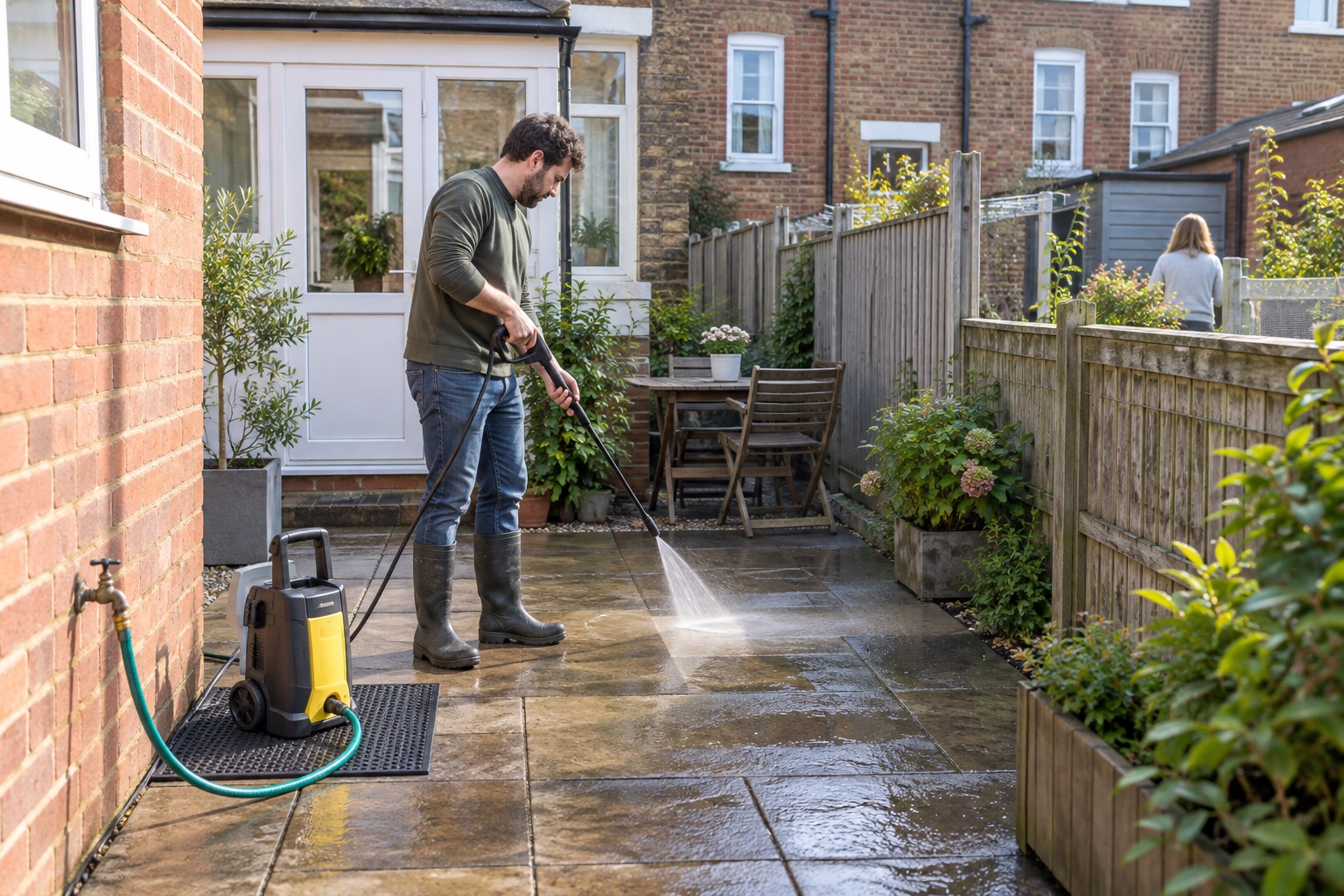
The motor and pump are only part of what neighbours hear. A concentrated jet striking a hollow fence panel, corrugated shed or enclosed courtyard can be sharper than the machine itself. Wheels and hard plastic can vibrate against paving, while repeated stop-start operation creates an obvious changing sound.
Published sound figures are not always presented under directly comparable conditions. Treat a single number carefully and consider the complete job: how long it will run, where the machine can sit and what the water jet will hit.
A smaller machine is not automatically the quietest choice
A longer session and repeated jet impact can matter to neighbours even when a machine has a lower declared emission value. The table does not establish cleaning speed or total-job exposure. Choose a suitable method and do the sweeping, setup and preparation with the motor off.
How to make pressure washing less disruptive
- Work during normal daytime hours and avoid early mornings, evenings and long continuous sessions.
- Sweep first so the machine is used only where water pressure adds value.
- Move the motor away from party walls, shared fences and corners that reflect sound.
- Place it on a stable manufacturer-permitted surface; do not cover ventilation openings or improvise an enclosure.
- Use a broad fan and the lowest effective setting to reduce harsh impact noise.
- Prepare hoses, attachments and the work area before switching on.
For a small terrace, also consider whether a brush, suitable cleaner and ordinary rinse will complete the task with less water and disturbance.
Hearing protection still matters
Neighbour-conscious operation does not guarantee a safe level for the person standing beside the machine. Follow the manual and any stated hearing-protection requirement. Eye protection, stable footwear, RCD protection and control of bystanders remain necessary.
Frequently asked questions
What is the quietest pressure washer?
There is no reliable universal winner because published figures, settings and operating conditions differ. Choose an appropriately sized machine, compare official sound data where available and consider total working time.
Are cordless pressure washers quieter?
Not automatically. Compare the exact model's declared figures on the same basis; the motor, water jet, surface and job duration all affect the result.
When is it reasonable to pressure wash in a terraced garden?
Use normal daytime hours, check local or tenancy rules and avoid prolonged sessions. Giving close neighbours advance notice is considerate when the work will take time.
Can I put a box around a pressure washer to reduce noise?
No improvised enclosure should obstruct cooling or create an electrical or water hazard. Use only placement and accessories permitted by the manufacturer.
Will a lower pressure setting reduce noise?
It can reduce impact noise at the surface, but the motor behaviour varies by machine. Use the lowest effective setting because it also reduces damage risk.
Why is a sound-power number higher than sound pressure?
They describe different quantities, with different measurement bases. Do not compare one machine's LpA with another's LWA or use either as a prediction at your neighbour's window.