
Patio problem-solving guide
How to remove black spots from a patio
Identify and treat patio black spots without unsafe chemical mixtures or damaging pressure, with material checks for stone, concrete and porcelain.
What the spots are
Dark spots are a clue, not a diagnosis
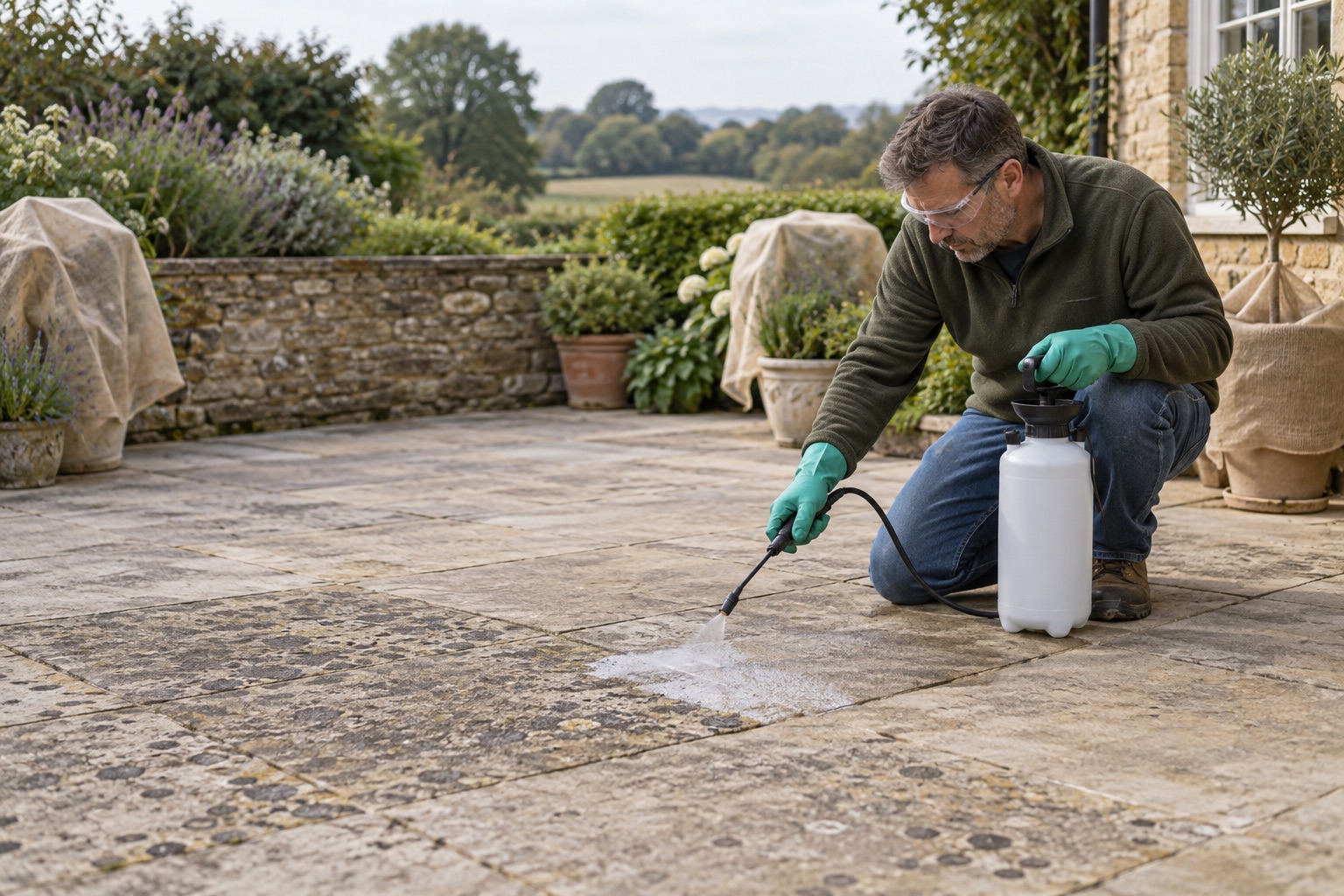
Small dark colonies can sit within pores and surface texture, which is why ordinary washing may clean around them without removing them. Confirm that the marks are biological growth rather than mineral staining, paint, metal corrosion or damage before applying a treatment.
Photograph the dry surface, identify the paving and check the supplier’s care information. Lichen removal is rarely a one-pass transformation; a safe result may fade over time or need a permitted repeat application.
A colour is a clue, not a diagnosis. Inspect from standing height, photograph the dry surface and identify the paving/finish. Do not scratch it, add acid or apply a stronger cleaner to find out what a mark is.
Scroll sideways on smaller screens. Several causes can overlap; the next step is a decision route, not a guaranteed identification.
| Possible cause | Clues, not proof | Safer next step | What not to assume |
|---|---|---|---|
| Algae or algae-like growth | Green surface film on damp, shaded paving; some growth can look dark and crusty when dry. | Use the algae guide: deal with slip risk, loose debris and drainage before deciding whether a compatible treatment is needed. | Dark colour alone does not establish lichen. A black-spot remover is not the automatic first purchase. |
| Possible lichen | Adherent crusts or small colonies that remain after ordinary dirt is washed away. Lichens vary in colour and can occur in bright as well as damp positions. | Confirm material compatibility, then follow the label-led lichen treatment route below, only if removal is necessary. | Persistent dots are not proof; do not keep moving a rotary jet closer or exceed the product label. |
| Rust or mineral staining | Orange/brown staining near metal furniture, fixings or tools; iron within some natural stone can also oxidise. | Follow the rust-stain guide and identify the external source or speak to the stone supplier before treatment. | A biological-growth cleaner does not remove every mineral stain. Acid can damage susceptible stone and cementitious paving. |
| Salts / possible efflorescence | White haze or deposits, rather than typical dark colonies. On concrete paving, cement-related efflorescence can be temporary. | Check Marshalls' concrete-paving explanation and the concrete-slab guide; allow the supplier to distinguish salts from other marks. | Do not prescribe a black-spot remover or an acid rinse for an unidentified white deposit. |
| Possible material or joint deterioration | Flakes, loose grains, crumbling edges, failed joints or rocking slabs accompany the discolouration. | Stop cleaning the affected patch. Use the pointing-protection guide and arrange material/repair advice before choosing another cleaner. | A treatment cannot restore lost stone, sound joints or secure paving; more force can increase damage. |
| Uncertain or mixed marks | Paint, oil, shadows, growth and mineral stains can coexist; a photo may not distinguish them. | Keep a record and identify the surface through its supplier. Start only with a permitted gentle cleaning method once structural condition is sound. | Do not combine chemicals or regard a patch result as proof of a particular organism. |
The growth clues follow the RHS hard-surface growth guidance; mineral and efflorescence distinctions follow Marshalls' paving information. These clues narrow the next action; they do not establish the condition of your paving.
Once the mark is identified, check the material
| Surface | Start with | Avoid | Expectation |
|---|---|---|---|
| Sandstone | Stone-safe labelled lichen treatment | Acids and close jetting | Gradual improvement |
| Limestone | Limestone-approved non-acid treatment | Acidic products | Test for colour change |
| Concrete | Concrete-compatible specialist product | Uncontrolled runoff | Repeat only as label permits |
| Porcelain | Clean surface and verify mark | Abrasive scraping | Easier release if truly surface growth |
| Unknown paving | Identify or seek advice | Trial-and-error chemicals | No treatment until confirmed |
Treatment only after the material checks
Match the treatment to the paving
This is for manufacturer-approved exterior masonry, not a blanket recommendation for limestone, porcelain or coated stone. Patch test and follow the full safety label.
 View product on Amazon
SCRUBB Black Spot Remover 5L
Best for: Black-spot treatment on manufacturer-approved exterior masonry
A specialist black-spot treatment intended for exterior masonry. Confirm your paving and any sealer are approved, then patch test and follow the safety, contact-time and runoff instructions.
Do not assume suitability for limestone, porcelain or a coated surface without explicit maker confirmation.
- 5 l
- Exterior masonry
- Patch test
- Follow label
A controlled black spot treatment sequence
- Sweep and wash off loose grime so the treatment reaches the growth.
- Select a UK-authorised product whose label names the surface and intended use.
- Read the entire label before opening it, including PPE, weather, access and environmental controls.
- Protect or move pots and follow the label around plants, pets, children, metals, ponds and drains.
- Treat a small inconspicuous patch at the stated dilution and contact time.
- Rinse, leave or repeat only as the label directs, then judge the dry result.
Never mix patio treatments with bleach, acids, vinegar or other cleaners. Mixing can create dangerous reactions and makes material compatibility unpredictable.
The paving decides what is safe
On sandstone and limestone, avoid acidic products and be alert to colour change. Concrete needs a product compatible with cementitious surfaces and any coating. Porcelain absorbs little water, but its jointing and nearby materials still constrain the treatment.
If a product label does not clearly include your surface, do not assume it is suitable. Contact the product maker or paving supplier with the exact names and photographs.
Rinsing, not blasting
A pressure washer may help rinse robust paving after treatment
Where both the paving guidance and treatment label allow it, the Kärcher K 4’s adjustable output or the Bosch UniversalAquatak 135’s strong flow can help rinse a broad area. Begin with a fan at low pressure and keep the jet away from joints. The chemical does the treatment work; a rotary nozzle is not a substitute.
 View product on Amazon
Kärcher K 4 Power Control Flex
Best for: Mixed household cleaning where control and an 8 m flexible hose matter
A balanced mains machine for patios, cars and general outdoor work. Its useful advantage is not extreme pressure but adjustable output, a flexible 8 m hose and a stable mid-range flow rate.
What stands out
- 20–130 bar adjustment
- 8 m PremiumFlex hose
- 420 l/h maximum flow
Keep in mind
- The base package does not include a surface cleaner
- At 12.1 kg before accessories it is not the lightest option
- 20–130 bar
- 420 l/h
- 8 m hose
- Mains · 1.8 kW
 View product on Amazon
Bosch UniversalAquatak 135
Best for: Smaller homes wanting one compact machine with a multi-pattern nozzle
A compact 135-bar washer with a strong 450 l/h maximum flow and a practical three-in-one nozzle. It reduces attachment swapping for routine car, furniture and small-patio jobs.
What stands out
- 450 l/h maximum flow
- Three spray patterns in one nozzle
- 7.9 kg machine weight
Keep in mind
- No surface cleaner in the standard box
- The 7 m PVC hose is shorter and less flexible than some rivals
- 135 bar max
- 450 l/h
- 7 m hose
- Mains · 1.9 kW
Read how to pressure wash a patio safely before machine rinsing.
Reduce the damp conditions that favour lichen
Sweep organic debris, move pots, clear blocked channels and investigate standing water. Improve airflow where practical without harming established planting. These steps cannot guarantee that airborne lichen will stay away, but they make the surface less persistently damp and simplify routine cleaning.
The Health and Safety Executive says biocidal products must be used for their authorised purpose and according to label controls, including environmental protection and disposal.
Frequently asked questions
What causes black spots on patio slabs?
They are commonly lichen colonies anchored in pores and texture, though some dark marks are mineral or metal stains. Identify the mark before treatment.
Will a pressure washer remove patio black spot?
It may lighten the surrounding grime but often leaves established lichen behind. Aggressive close jetting risks damaging stone and pointing.
Can I use bleach on patio black spots?
Do not improvise bleach mixtures. Choose an authorised, labelled product compatible with the exact paving and follow every instruction.
How long does black spot remover take to work?
It depends entirely on the labelled product, growth and material. Some results are gradual. Do not extend contact time or repeat more often than permitted.
Why did the spots return?
Spores, shade, moisture and organic debris remain outdoors. Regular sweeping, drainage checks and label-compliant maintenance reduce recurrence but cannot eliminate it.