
Patio cleaning method
How to use patio cleaner safely
A practical patio-cleaner method covering surface checks, label dilution, patch testing, safe application and controlled rinse water.
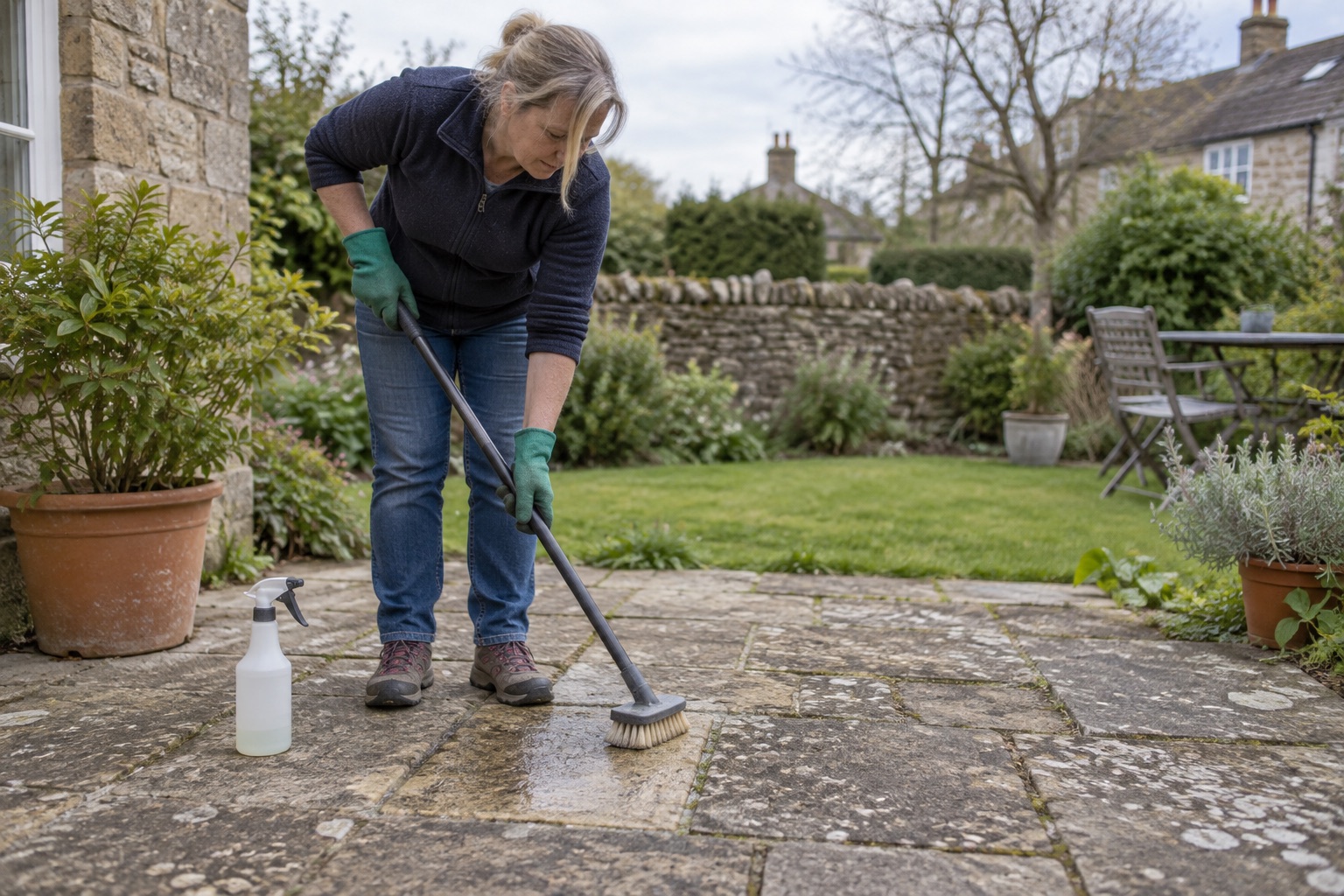
1. Identify the material and the mark
Concrete, porcelain, sandstone and limestone have different chemical tolerances. Check the installer or paving maker's care instructions and the cleaner label for that exact material and finish. A product for ordinary grime may not remove rust, oil or black-spot growth. If the surface is loose, flaking, newly laid or sealed with an unknown treatment, pause and get specific guidance. The patio-cleaner comparison helps match product type to soil.
Remove toys, furniture and loose debris. Keep children and pets away for the period the label specifies. Wear the stated protective equipment; avoid spray drift onto plants, metal trim or neighbouring property. Do not work in conditions that make the product dry too fast or wash into a drain or pond. Identify the water route in advance and choose a contained test area.
2. Follow the exact bottle—not a generic recipe
Read the current hazard, dilution and application instructions in full. HG Patio-Tile Cleaner, for example, calls for pre-wetting suitable tiles, dilution, scrubbing and rinsing before it dries. A leave-on algae treatment follows a materially different process. Never assume that a stronger mix, longer dwell or pressure-washer tank improves the result. Do not mix products.
Make a small inconspicuous patch at the labelled strength. Allow it to dry completely before judging colour or texture; a wet paving slab can hide etching or uneven cleaning. If it passes, treat manageable sections so you can maintain the required contact time. Brush only as firmly as the surface allows. Use the specified rinse method and collect or control dirty water rather than flushing it towards a road gully.
Calculate a label-based mix without changing its strength
First decide whether you are measuring water or making a final volume. At 1:4 product : water, 5 litres of final mix needs 1 litre product and 4 litres water; adding product to 5 litres of water instead makes 6.25 litres. That distinction avoids both an over-strong mix and an overflowing container.
Follow the bottle
Label-based dilution calculator
Select an exact product example or enter a ratio explicitly stated as product : water by volume. A 1:4 ratio means one part product plus four parts water—not one part in four parts of final mixture.
Example: 5 litres of HG mixture
- Product to measure
- 1,000 ml product
- Water to measure
- 4 litres water
- Final mixture
- 5 litres mixture
Product : water = 1 : 4. Final mixture: 5 litres.
HG Patio-Tile Cleaner, 1 litre concentrate. Apply and rinse as the label directs; this does not approve pressure-washer dosing.
The result is arithmetic, not chemical or surface approval. Do not increase concentration, mix cleaners or use a patio product in a pressure washer unless both instructions permit it. Wear label-specified protection, control runoff and make only what you need.
| Exact product example | Product : water | Final mixture | Product | Water |
|---|---|---|---|---|
| HG Patio-Tile Cleaner — 1 litre concentrate | 1:4 | 2.5 l | 500 ml | 2 l |
| HG Patio-Tile Cleaner — 1 litre concentrate | 1:4 | 5 l | 1,000 ml | 4 l |
| HG Patio-Tile Cleaner — 1 litre concentrate | 1:4 | 10 l | 2,000 ml | 8 l |
| Wet & Forget Outdoor — original concentrate | 1:5 | 2.5 l | 416.7 ml | 2.083 l |
| Wet & Forget Outdoor — original concentrate | 1:5 | 5 l | 833.3 ml | 4.167 l |
| Wet & Forget Outdoor — original concentrate | 1:5 | 10 l | 1,666.7 ml | 8.333 l |
Label examples checked September 2026: HG UK bottle label; Wet & Forget UK directions. Your current bottle takes precedence if the formulation or instructions differ.
Keep product quantity separate from dilution
Coverage tells you how much product to buy; dilution tells you how to mix that product. More water at the same amount of cleaner does not create extra label-approved coverage. Use the patio-cleaner quantity planner first, then calculate a manageable batch here. Neither calculation replaces material approval, patch testing, protective equipment or runoff control.
 View product on Amazon
HG Patio-Tile Cleaner 1L
Best for: Gravel and concrete patio tiles and other paving approved by the label
A concentrated brush-on cleaner for ordinary grime on the patio materials named by HG. It is not a black-spot, rust or oil-stain treatment.
Pre-wet, dilute, scrub and rinse according to the current bottle; do not assume suitability for limestone or an unidentified sealed finish.
- 1 litre
- Concentrate
- Gravel and concrete tiles
- Brush and rinse
3. Inspect after drying and prevent a repeat
Let paving dry before deciding whether the stain remains. If a mark is unchanged, reconsider the diagnosis instead of immediately repeating a general cleaner. Rust from a metal chair foot needs the source removed; recurring algae suggests shade and prolonged damp; oil needs an absorber, not a routine patio wash. See the method comparison for when mechanical cleaning is useful.
Rinse tools as their instructions require and retain chemicals in their original, closed packaging. Dispose of leftover solution and captured wastewater according to the label and local water-company or council advice; do not pour it into a surface drain. Our runoff guide explains why drainage type matters.
Frequently asked questions
Do I need to wet the patio first?
Only if the specific cleaner instructs it. HG Patio-Tile Cleaner does; some leave-on products require a dry surface.
How long should cleaner stay on?
Use the current label's dwell time and prevent unintended drying. There is no safe universal time.
Can I use patio cleaner on limestone?
Only when the exact label and limestone supplier permit it. Never assume a general patio cleaner is suitable.
Can I put it through a pressure washer?
Only when both the cleaner and the washer manual approve that use.
What if the cleaner reaches a road drain?
Stop the flow if safe, contain what you can, and follow local water-company or environmental authority advice for a spill.