
Cleaning method comparison
Soft washing vs pressure washing
Compare low-pressure chemical treatment and pressure-washer cleaning by surface, speed, risk, runoff and suitability for render, brick, paving and vehicles.
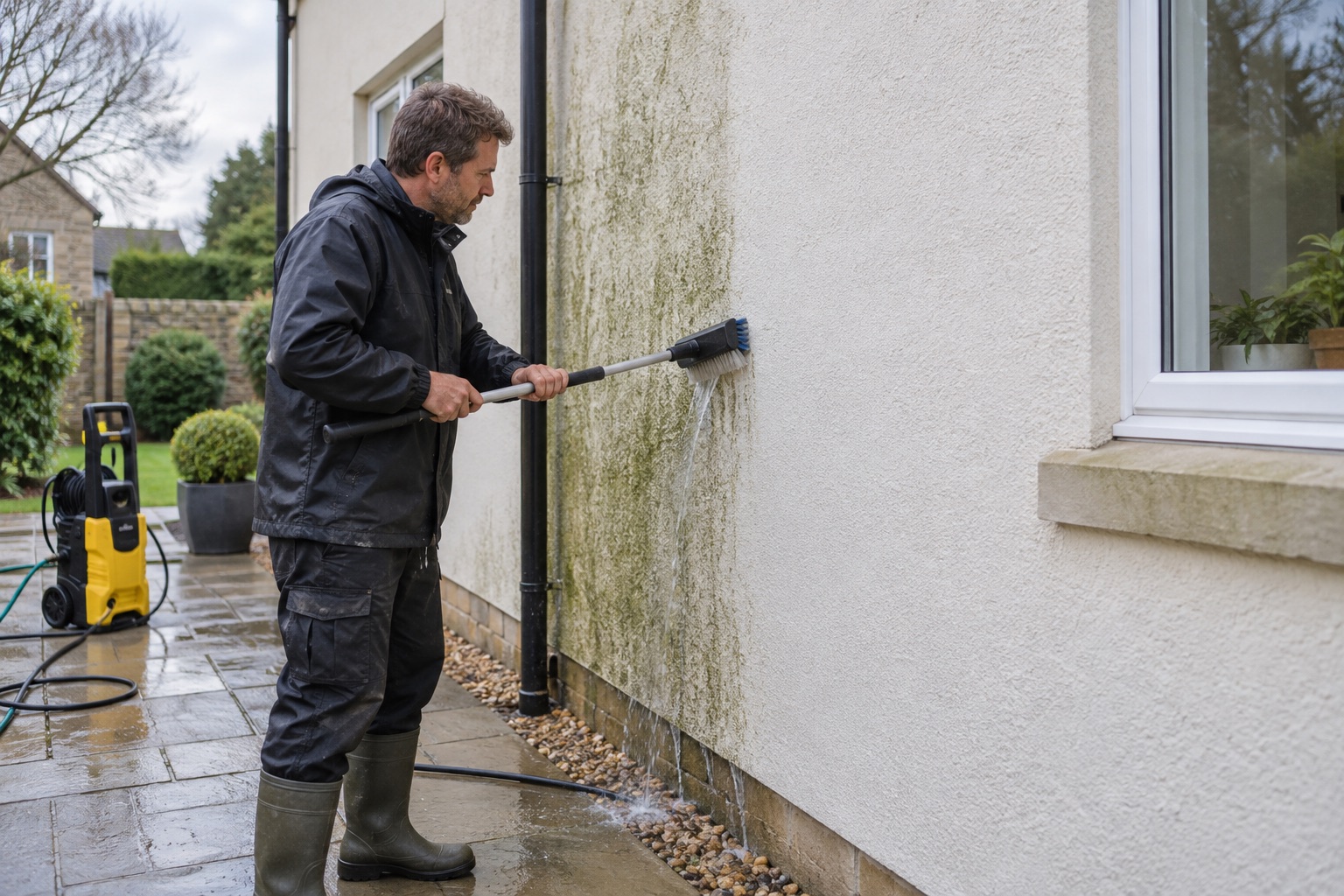
GARDENA describes its water-fed soft wash set for larger delicate surfaces, while chemical soft-wash products have their own label directions. The two methods should not be treated as interchangeable. See GARDENA's intended use.
“Soft wash” describes a method, not one magic liquid
A soft wash normally uses a low-force application of a cleaning treatment, followed by either a specified dwell and rinse or gradual weathering, depending on the product. It is especially relevant to algae and other biological staining where brute force risks the substrate. A pressure washer instead uses water impact to detach soil. The maximum bar number printed on the machine does not tell you what force will reach a fragile wall: nozzle shape, working distance and operator technique matter.
| Factor | Soft washing | Pressure washing |
|---|---|---|
| Main action | Labelled cleaner plus low-force application | Mechanical water jet |
| Speed of appearance | Often gradual for biological growth | Immediate removal of loose dirt |
| Main risk | Wrong chemistry or runoff | Abrasion and water ingress |
| Best first check | Surface and cleaner compatibility | Surface condition and nozzle control |
Both methods still need preparation, safe access and containment. A chemical method is not harmless just because pressure is low. A water-only jet is not automatically chemical-free when it dislodges oily or contaminated material.
Choose by material, not a universal favourite
Render and painted masonry: verify the coating system, repair defects and favour low-force maintenance. Older brick: protect soft faces and lime joints; the Brick Development Association warns against casual jet washing. Sound concrete paving: a controlled pressure wash may be appropriate after a test, while algae treatment can help prevent rapid regrowth. Cars: use a broad controllable rinse and car shampoo; do not apply wall biocide. Bicycles and e-bikes: follow component and electrical-system guidance; a bucket and brush are often the better method.
Start with our specific guides for render, brick and patios rather than transferring one method across surfaces.
Read the label and plan where liquid goes
Check that the treatment is authorised for the exact substrate, coating and stain. Follow dilution, personal protection, weather, contact time and rinse instructions. Do not mix cleaners. Protect plants and keep product or contaminated wash water away from ponds and surface-water drains as directed. A contractor should be able to explain treatment chemistry and runoff control before work begins.
Two different components of a low-force setup
The GARDENA soft brush is a contact tool for sound reachable surfaces; it is not a chemical treatment. Wet & Forget is a labelled outdoor treatment for organic growth on approved materials; it is not a general-purpose detergent. Check both against your wall or paving maker’s instructions before combining them.
 View product on Amazon
GARDENA Cleansystem Soft Wash Set
Best for: Ground-level cleaning of sound, delicate exterior finishes after a patch test
A 90 cm water-fed handle and soft brush for controlled cleaning of larger sensitive surfaces. Use light contact and check the wall finish maker's guidance; the included cleaning tabs are not automatically suitable for render or paint.
A gentle tool, not a guarantee that a fragile coating or loose render can be scrubbed safely.
- 90 cm handle
- Soft brush
- Adjustable water flow
- Hose connection
 View product on Amazon
Wet & Forget Outdoor Cleaner 5L
Best for: Label-approved outdoor surfaces with algae, mould or lichen
A concentrated outdoor treatment for organic growth on many exterior surfaces. It is a treatment, not an instant pressure-washing substitute; follow the label for dilution, weather and runoff.
Check the exact surface and any sealer with the maker before use; keep it out of ponds and follow plant and pet precautions.
- 5 l concentrate
- Outdoor surfaces
- Organic growth
- Label-led dilution
A simple decision path
- Identify the surface and inspect for cracks, loose coatings or weak joints.
- Identify the deposit: dirt, biological growth, salt, oil and paint require different treatment.
- Check the surface maker’s cleaning permissions, then patch test the least forceful method.
- Use pressure only where allowed and where a controlled fan gives a clear advantage.
- Reassess after drying; do not escalate force to compensate for a stain that needs diagnosis.
Our manual exterior-wall guide gives a practical low-force sequence. For the machine decision, see how to choose a pressure washer.
Frequently asked questions
Is soft washing the same as low-pressure rinsing?
Not always. Soft washing normally includes a surface-compatible treatment; low-pressure rinsing may use only water.
Is soft washing safe for all render?
No. Render type, coating condition and treatment chemistry must all be checked. Damaged render needs repair first.
Does soft washing work immediately?
Some treatments act gradually over weathering cycles. Follow the product’s stated method and realistic time frame.
Can a pressure washer remove algae without chemicals?
It can detach visible growth from robust surfaces, but may leave conditions for regrowth and can damage delicate materials.
Which method is better for brick?
Condition decides. For old or lime-mortared brick, gentle hand cleaning or specialist assessment is safer than casual jet washing.