
Resin-bound driveway guide
How to clean a resin-bound driveway
Clean a resin-bound driveway with routine sweeping, compatible detergent and controlled cold-water rinsing while protecting the resin and drainage.
Surface first
Confirm resin-bound, resin-bonded or coated
A resin-bound surface mixes aggregate through resin before laying, producing a relatively smooth, often permeable layer. Resin-bonded surfacing has aggregate scattered onto resin and usually feels rougher. The names are frequently confused, but cleaning limits can differ. Check paperwork, ask the installer or identify the product before choosing a method.
Inspect for cracking, soft patches, loose stone, tyre scuffs and edge failure. Clear leaves promptly so tannins and damp organic matter do not sit on the finish. Keep adjacent gullies open, but collect grit rather than sweeping it straight into the drainage system.
| Condition | Start with | Escalate to | Avoid |
|---|---|---|---|
| Loose leaves and grit | Soft broom | Hose rinse | Grinding debris under a stiff tool |
| General traffic film | Mild detergent and brush | Permitted cold-water fan rinse | Solvents or neat chemicals |
| Algae in a shaded patch | Labelled compatible treatment | Repeat gentle brushing | Unlabelled chemical mixtures |
| Oil or grease mark | Absorb promptly and seek system guidance | Approved degreaser | Petrol or solvent cleaning |
| Cracking or loose aggregate | Stop and photograph | Installer assessment | Pressure washing the defect |
Routine cleaning without unnecessary force
- Sweep first. Use a medium or soft broom to lift leaves, grit and seeds without scouring the surface.
- Test the cleaner. Choose a mild household detergent or proprietary product accepted by the surface maker and test a discreet patch.
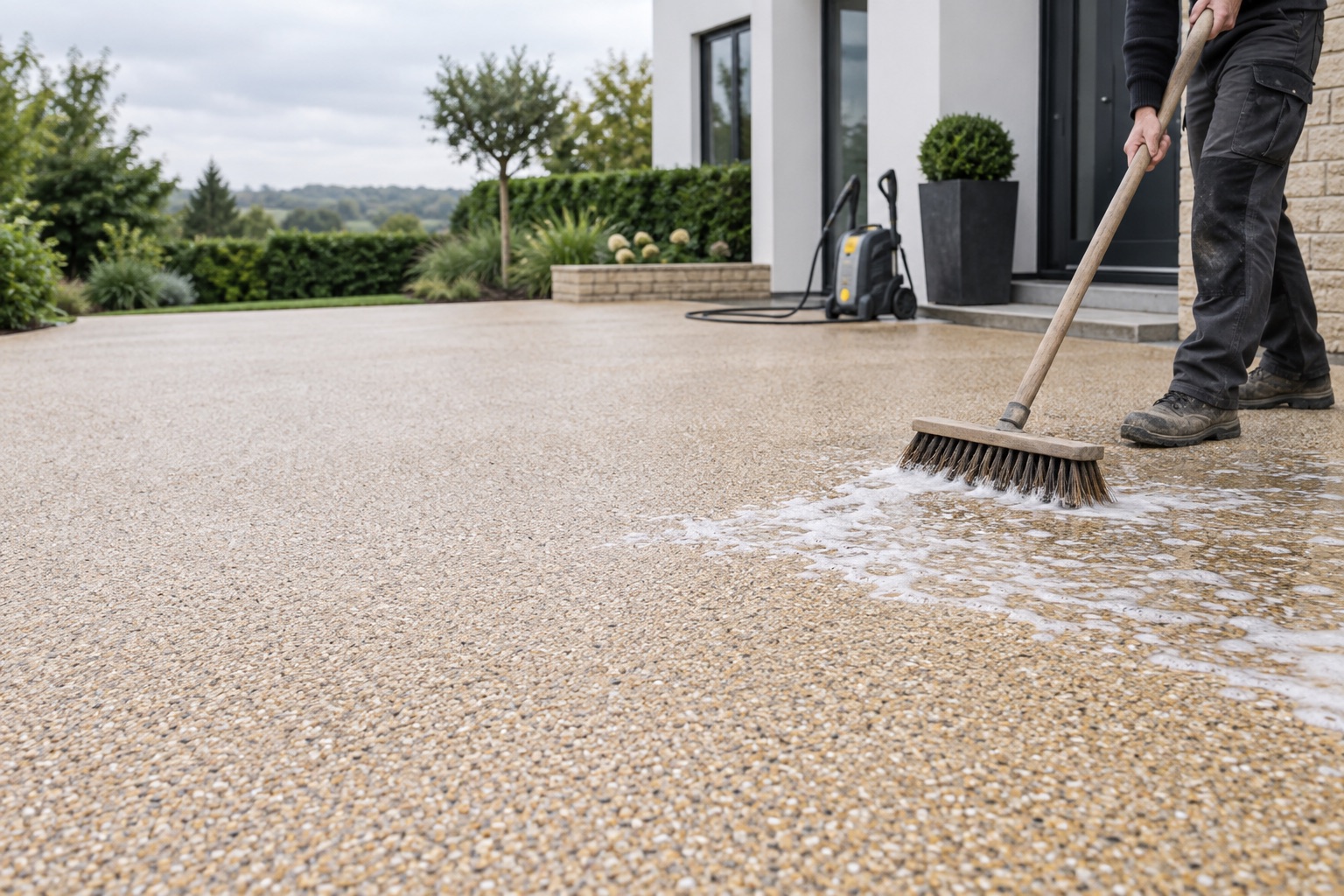
- Brush evenly. Work warm solution over a small area with a non-metal brush. Do not allow dirty liquid to dry back onto the surface.
- Rinse thoroughly. Use clean water and direct residue to a lawful collection or drainage point without flooding borders.
- Inspect when dry. Colour and texture changes are difficult to judge while the aggregate is wet.
When pressure washing is permitted
Use the exact system’s aftercare rules. SureSet, for example, allows a cold-water pressure washer up to 150 bar on its resin-bound surfacing while specifying at least 200 mm distance, a sweeping motion and no excessive pressure. Another installer or resin formulation may set a different limit.
Begin well below the maximum with a broad fan. Keep moving, avoid concentrating the jet at cracks and edges, and do not use a rotary nozzle. Pressure washing should rinse released dirt, not cut a clean line through the surface. If aggregate loosens or the sheen changes, stop.
Controlled options
Choose adjustment and a predictable fan
The Kärcher K 4 Power Control Flex offers a broad adjustable range, while the compact 120-bar AVA Go P40 Medium is easy to store near a small drive. The Bosch UniversalAquatak 135 adds higher maximum flow for rinsing. The surface manufacturer’s limit always overrides the machine’s available output.
 View product on Amazon
Kärcher K 4 Power Control Flex
Best for: Mixed household cleaning where control and an 8 m flexible hose matter
A balanced mains machine for patios, cars and general outdoor work. Its useful advantage is not extreme pressure but adjustable output, a flexible 8 m hose and a stable mid-range flow rate.
What stands out
- 20–130 bar adjustment
- 8 m PremiumFlex hose
- 420 l/h maximum flow
Keep in mind
- The base package does not include a surface cleaner
- At 12.1 kg before accessories it is not the lightest option
- 20–130 bar
- 420 l/h
- 8 m hose
- Mains · 1.8 kW
 View product on Amazon
AVA Go P40 Medium
Best for: Cars, bikes and smaller outdoor areas where storage space is tight
A genuinely compact 120-bar mains washer with an 8 m flexible hose and 390 l/h flow. The small body and stored accessories make it appealing for sheds, garages and mobile car-care setups.
What stands out
- Compact body with stored accessories
- 8 m flexible hose
- Ten-year warranty when registered under AVA's terms
Keep in mind
- No surface cleaner in the Medium bundle
- Lower flow than the mid-range corded leaders here
- 120 bar max
- 390 l/h
- 8 m hose
- Mains · 1.7 kW
 View product on Amazon
Bosch UniversalAquatak 135
Best for: Smaller homes wanting one compact machine with a multi-pattern nozzle
A compact 135-bar washer with a strong 450 l/h maximum flow and a practical three-in-one nozzle. It reduces attachment swapping for routine car, furniture and small-patio jobs.
What stands out
- 450 l/h maximum flow
- Three spray patterns in one nozzle
- 7.9 kg machine weight
Keep in mind
- No surface cleaner in the standard box
- The 7 m PVC hose is shorter and less flexible than some rivals
- 135 bar max
- 450 l/h
- 7 m hose
- Mains · 1.9 kW
See how these compare for reach and control in best pressure washers for driveways.
Treat spills early and do not improvise solvents
Blot oil or grease rather than spreading it with a jet. Ask the system provider which degreaser is compatible and test it away from the main view. Petrol and strong solvents can soften or discolour some resins; keep leaking vehicles off the area until repaired.
For algae, choose a product explicitly labelled for the surface and follow its dilution, dwell time, protective-equipment and runoff instructions. Do not mix cleaners. If the driveway is permeable, that is not permission to wash biocide or contaminated liquid through it.
System-specific maintenance guidance
SureSet’s resin-bound aftercare guidance provides one manufacturer example for sweeping, detergent, cold-water pressure cleaning and solvent precautions. Use the documentation for your installed system where it differs.
Frequently asked questions
Can you pressure wash a resin-bound driveway?
Often, but only within the installed system’s guidance. Use cold water, a wide fan, generous distance and a low starting pressure; avoid rotary nozzles and damaged areas.
What is the difference between resin-bound and resin-bonded?
Resin-bound surfacing mixes aggregate and resin before laying. Resin-bonded systems scatter stone onto a resin coat. Their texture, permeability and aftercare can differ.
How do I remove tyre marks?
Start with compatible mild detergent and brushing. Persistent rubber or chemical staining should be referred to the installer before stronger treatment is tried.
Can I use bleach on a resin driveway?
Only if the exact resin-system maker and product label permit it. A generic household bleach recommendation risks colour change, vegetation damage and unlawful runoff.
How often should a resin-bound driveway be cleaned?
Sweep as debris accumulates and spot-clean spills promptly. Schedule a deeper clean by condition, shade and traffic rather than an arbitrary fixed interval.