
Concrete driveway guide
How to clean a concrete driveway
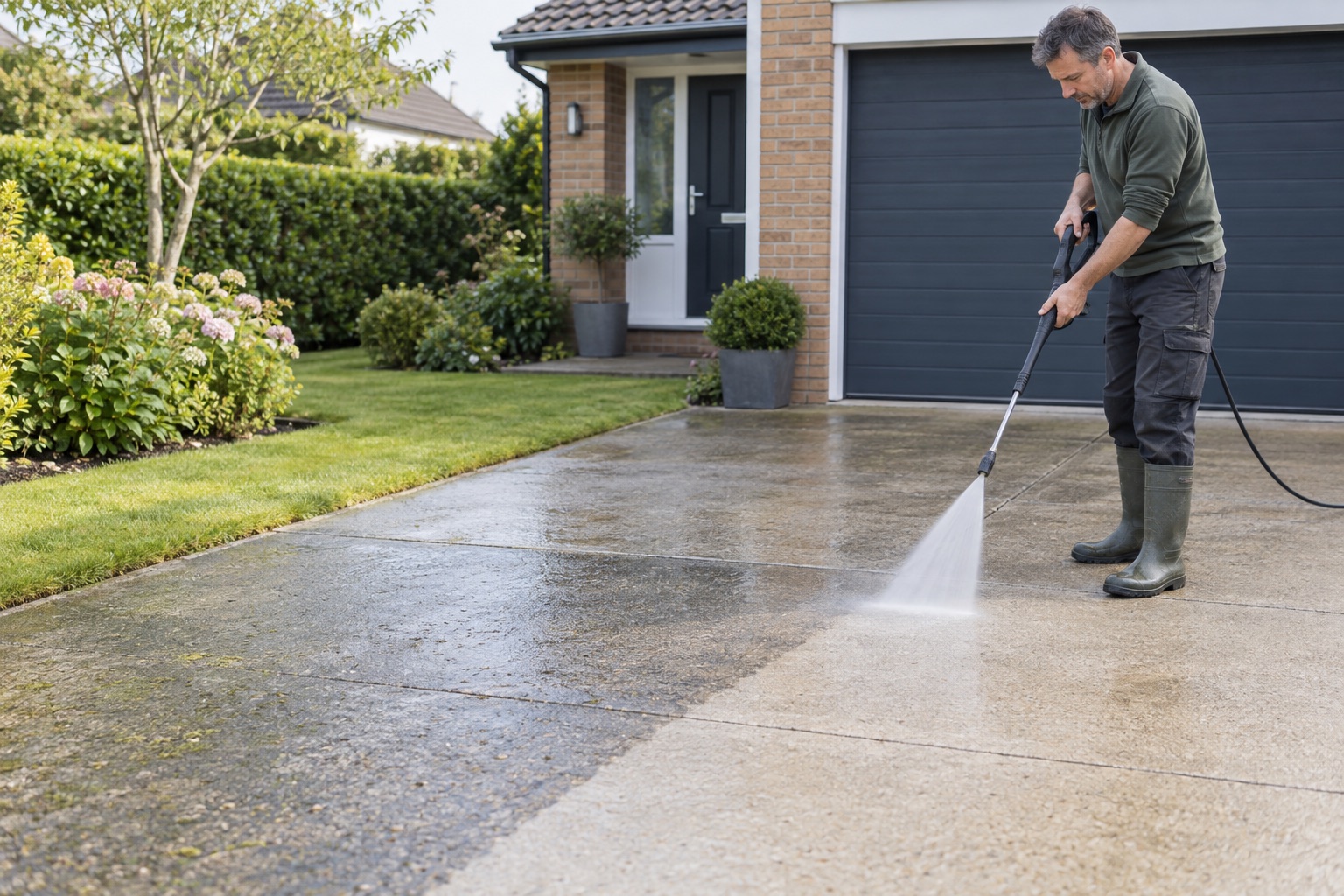
Clean a concrete driveway with targeted stain treatment, controlled pressure washing and even rinsing while protecting joints, edges, drains and sealers.
Useful products for the job
Start with the stain and the surface
Manual scrubbing suits many surface marks; an enclosed head is a companion only to a compatible Kärcher machine on sound concrete.
 View product on Amazon
Newman and Cole Deck Scrubber Brush
Best for: Robust paving and sound timber that tolerate a stiff brush
A long-handled stiff brush for loosening surface dirt without a pressure washer. Test a small patch first; soft stone, delicate pointing and composite boards may need a gentler brush.
Use only where the surface maker permits firm brushing; protect joints and finishes.
- Stiff bristles
- Long handle
- Manual cleaning
- Test first
 View product on Amazon
Kärcher T 5 T-Racer Surface Cleaner
Best for: Broad-area cleaning with a compatible Kärcher K-series washer
A twin-jet enclosed surface head that reduces splash on suitable patios and other robust surfaces. It is an attachment, not a standalone cleaner; confirm the exact washer and nozzle compatibility.
Especially relevant alongside the Kärcher K 4; do not imply it fits Bosch, Nilfisk or AVA machines.
- Twin rotating jets
- Kärcher K-series
- Attachment only
- Check surface
Preparation first
Plain, decorative, sealed and damaged concrete are different jobs
Inspect the drive in dry light. Look for sealer, colour hardener, stamped texture, old repairs, spalling, cracks and soft edges. A sound slab can take more controlled rinsing than a weathered decorative finish. If you cannot identify a coating, test by hand before introducing pressure.
Sweep thoroughly, clear channel grates and protect walls, doors and vehicles from overspray. Decide how oily or chemically contaminated water will be contained. A clean-looking drain is not a disposal route for detergent, oil or biocide.
| Condition | Start with | Pressure-washing limit | Next step |
|---|---|---|---|
| Sound plain concrete | Detergent and stiff brush | Broad fan and low test setting | Clean in full sections |
| Stamped coloured or sealed concrete | Finish-maker guidance | Do not assume plain-concrete tolerance | Test for whitening or lift |
| Spalling or exposed aggregate | Gentle hand cleaning | Avoid the defect | Arrange repair advice |
| Oil stain | Absorb and use compatible degreaser | Do not spread with the jet | Contain residue |
| Rust or fertiliser mark | Diagnose the source | Avoid acid improvisation | Use labelled concrete treatment |
A consistent concrete driveway cleaning method
- Remove dry debris. Sweep grit from corners, joints and drainage channels before it becomes abrasive slurry.
- Pre-treat the actual stain. Use a concrete-compatible labelled product and give it the specified dwell time without letting it dry.
- Test a broad fan. Begin at low pressure with the nozzle well back. Let the patch dry enough to reveal etching or colour change.
- Divide the area. Work between joints or natural boundaries using steady overlapping passes. Avoid writing clean lines into the slab.
- Rinse evenly. Move loosened material towards a controlled collection point and keep residue out of planting and drains.
- Check when dry. A wet surface hides stripes, pitting and whitening. Stop before a second pass if the finish has changed.
Match the cleaner to oil, algae, rust or tyres
Fresh oil should be absorbed before water is introduced. A compatible degreaser can lift remaining residue, but old penetration may not disappear completely. Rust, fertiliser and battery-acid marks need diagnosis; improvised acids can etch the cement paste and create a pale patch larger than the original stain.
For algae, first remove shade-trapping debris and correct standing water. If a biocidal cleaner is necessary, use an authorised product labelled for hard surfaces and control runoff exactly as directed. Never mix cleaning products.
Driveway-capable choices
Prioritise flow, reach and adjustable output
The Nilfisk Core 140 PowerControl provides in-hand adjustment in a lighter trolley format. Kärcher’s K 4 Power Control Flex combines a flexible eight-metre hose with a 20–130 bar range, while the Bosch UniversalAquatak 135 offers 450 l/h maximum flow. For any of them, the correct working setting is the lowest one that cleans the sound test patch.
 View product on Amazon
Nilfisk Core 140 PowerControl
Best for: Users who value in-hand adjustment and a lighter trolley format
A light trolley-format washer with power adjustment for mixed-garden jobs. The current Amazon page conflicts on supplied hose length, so confirm the exact bundle before buying it for reach.
What stands out
- Power adjustment
- Compact trolley format
- Useful mid-range output
Keep in mind
- Bundles differ between retailers
- A surface cleaner may still be an extra purchase
- 140 bar max
- 40 m²/h listed
- Confirm hose length
- Mains · 1.8 kW
 View product on Amazon
Kärcher K 4 Power Control Flex
Best for: Mixed household cleaning where control and an 8 m flexible hose matter
A balanced mains machine for patios, cars and general outdoor work. Its useful advantage is not extreme pressure but adjustable output, a flexible 8 m hose and a stable mid-range flow rate.
What stands out
- 20–130 bar adjustment
- 8 m PremiumFlex hose
- 420 l/h maximum flow
Keep in mind
- The base package does not include a surface cleaner
- At 12.1 kg before accessories it is not the lightest option
- 20–130 bar
- 420 l/h
- 8 m hose
- Mains · 1.8 kW
 View product on Amazon
Bosch UniversalAquatak 135
Best for: Smaller homes wanting one compact machine with a multi-pattern nozzle
A compact 135-bar washer with a strong 450 l/h maximum flow and a practical three-in-one nozzle. It reduces attachment swapping for routine car, furniture and small-patio jobs.
What stands out
- 450 l/h maximum flow
- Three spray patterns in one nozzle
- 7.9 kg machine weight
Keep in mind
- No surface cleaner in the standard box
- The 7 m PVC hose is shorter and less flexible than some rivals
- 135 bar max
- 450 l/h
- 7 m hose
- Mains · 1.9 kW
Our driveway pressure-washer comparison explains hose reach and flow, while the surface-cleaner guide covers flatwork attachments and bundle checks.
Let the driveway dry before judging the result
Rinse equipment according to its manual, remove collected sludge and keep traffic off until the surface is no longer slippery. Inspect joints, crack repairs and edges. New pitting, lines or exposed stone mean the method was too aggressive.
Do not apply sealer simply because the drive has been washed. Concrete moisture, curing, previous coatings and the chosen sealer all affect preparation. Follow the sealer maker’s drying and compatibility rules or use a specialist for decorative work.
Practical paving guidance
Marshalls’ technical information recommends sweeping first, testing a small section and using no more than medium pressure in its paving care advice. Your concrete and finish provider’s instructions take priority where they are more specific.
Frequently asked questions
What pressure should I use on a concrete driveway?
There is no universal safe number. Concrete strength, age, finish and condition vary. Begin low with a broad fan and use a dry test patch to set the limit.
Will pressure washing remove oil from concrete?
Pressure alone often spreads oily contamination. Absorb fresh oil and use a compatible degreaser before a controlled rinse.
Can I use a turbo nozzle?
Not as a starting tool. Its concentrated rotating jet can leave visible tracks or expose aggregate, especially on weathered or decorative concrete.
Should I use a surface cleaner?
It can improve consistency on large, flat, sound plain concrete. Test first, use the correct compatible head and inspect frequently because the shroud hides the immediate surface.
Why does the driveway look patchy after cleaning?
Wetness, uneven dwell time, overlapping passes, previous sealer and differences in wear can all cause patchiness. Let it dry fully before deciding whether further treatment is appropriate.