
Block paving follow-up
How to re-sand block paving after pressure washing
Refill block-paving joints with the right kiln-dried sand after cleaning, using dry-weather timing, careful sweeping and a complete final inspection.
Useful products for the job
The jointing material is the main purchase
Use fine kiln-dried sand only for a conventional flexible block-paving system, and never sweep it into damp joints.
 View product on Amazon
Laeto Kiln Dried Paving Sand 20kg
Best for: Refilling dry joints in conventional flexible block paving
Fine, dry jointing sand to brush into conventional block-paving joints once the whole joint depth has dried after cleaning. Confirm your installation uses this type of jointing material.
Not a substitute for proprietary permeable, resin or rigid jointing systems.
- 20 kg bag
- Kiln dried
- For block joints
- Apply dry
After the wash
Why full joints matter
In a conventional flexible block-paved driveway, jointing sand helps the individual blocks work together and limits movement. Pressure washing can lower the sand line even when the block faces look clean. Walk the whole area after it dries, paying close attention to wheel tracks, turning points, slopes and edges.
Re-sanding is not a cure for sinking, spreading or rocking blocks. Those symptoms point to an installation or drainage issue that should be corrected before loose material hides it. Likewise, do not assume every narrow joint takes kiln-dried sand: proprietary permeable, rigid and resin-jointed systems can require different materials.
| Condition | Ready to sand? | What to do |
|---|---|---|
| Blocks and joints dry throughout | Yes | Sweep the specified material in several directions |
| Surface dry but joints still dark or damp | No | Allow more drying time |
| Several blocks rock or sit low | No | Repair the installation before filling joints |
| Old sand remains near the top | Partly | Refill only the lost depth and avoid overfilling |
| Rigid or resin jointing was originally used | Check first | Follow that system’s repair instructions |
Choose the jointing sand specified for the paving
For standard flexible concrete or clay block paving, the usual choice is a fine, dry joint-filling sand sold for block paving. Its particle size and low moisture allow it to flow into narrow gaps. Builders’ sand and coarse sharp sand do not behave the same way and should not be improvised as substitutes.
Check the paving or installer’s guidance before buying. Estimate from the area, joint width and how much material was lost, then keep a little spare for the first follow-up inspection. Jointing sand contains fine mineral dust; follow the bag’s handling advice, wear suitable respiratory and eye protection and avoid raising dust around other people.
How to re-sand block paving
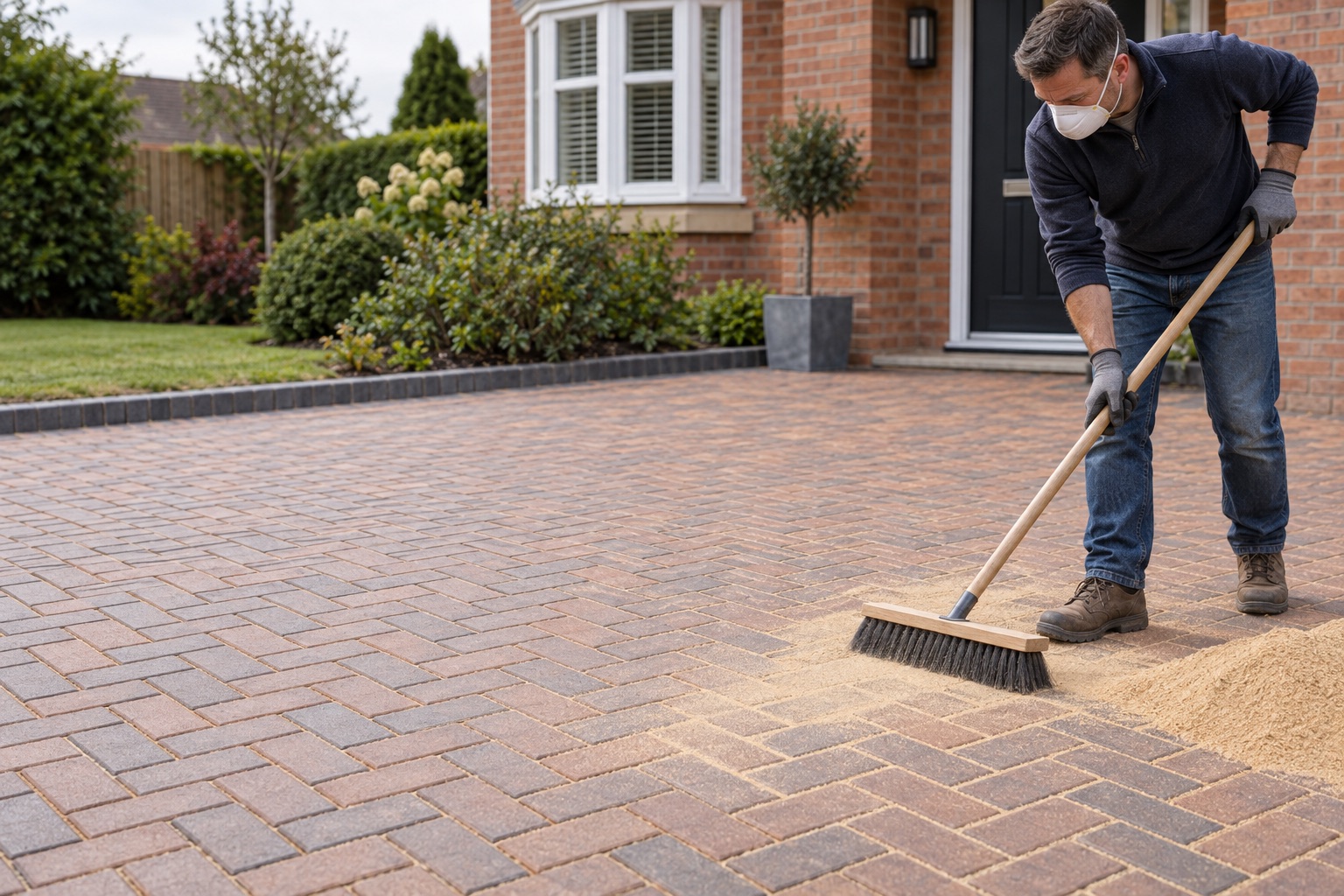
- Wait for a dry spell. The surface can look pale while moisture remains deeper in the joints. Give it enough time after washing and rain.
- Clear loose debris. Use a clean, dry broom. Do not wash the paving again immediately before sanding.
- Spread a manageable amount. Pour small piles rather than one large heap, then draw the material across the blocks.
- Sweep diagonally. Work in several directions so the sand finds each side of every joint instead of being dragged along one line.
- Settle it as specified. If the installation guidance calls for a vibrating plate, use the correct protective mat and technique or employ an experienced contractor. Small paths may have different requirements.
- Top up and inspect. Fill settled joints evenly without leaving mounds above chamfered edges. Remove all loose sand from channels and door thresholds.
Keep vehicles off until the joints are complete and the surface is cleared. Check again after initial use and after the next spell of dry weather; a small top-up is easier than allowing a shallow joint to deteriorate.
Plan the cleaning stage
Controllable washers reduce avoidable joint loss
Re-sanding begins with how the paving was cleaned. A broad-fan, stand-off approach may reduce joint loss, but no washer removes the need to inspect and refill disturbed joints. If cleaning is still ahead of you, make that separate equipment decision before starting the jointing work.
Use our block-paving washing method before this follow-up and compare suitable machines in best pressure washers for driveways.
Fix the cause of repeated sand loss
Sand that disappears soon after refilling can indicate concentrated roof runoff, overflowing channels, repeated close-range washing, poor edge restraint or block movement. Identify that cause rather than adding sand indefinitely. Ant activity and weeds can also reveal gaps, but they are not solved reliably by blasting the joints empty.
Marshalls describes fine kiln-dried sand as suitable for jointing concrete and clay block paving, and its laying guidance uses repeated sweeping and compaction until joints remain filled. Follow the instructions for your actual paving product and installation.
Technical references
See Marshalls’ joint-filling sand specification and its block-paving installation sequence. The product bag remains the authority for dust precautions, coverage and application conditions.
Take the plan outside
Block-paving re-sanding checklist
For a conventional flexible block-paving installation only. Confirm the specified joint material and method; permeable, rigid or resin-jointed systems can differ.
Tick on screen or leave blank to tick on paper. Nothing is saved or submitted. Printing includes this checklist only.
Exact model / material / product:
Notes / conditions:
Care references: Marshalls: block-paving finishing sequence; Marshalls: joint-filling sand specification. Checked September 2026. Your exact manual, material guidance and current label take priority.
Frequently asked questions
How long after pressure washing can I re-sand?
Wait until both the blocks and the full joint depth are dry. Weather, shade and drainage make a fixed number of hours unreliable.
Can I put kiln-dried sand on damp block paving?
No. It can clump and bridge near the top instead of flowing down the joint, leaving the paving looking full when it is not.
What sand should I use between paving blocks?
Use the material specified for the installation. Conventional flexible block paving normally uses fine kiln-dried jointing sand, while permeable or rigid systems may differ.
Should the sand reach the top of the blocks?
Fill to the level described by the paving maker, normally around the base of the edge chamfer rather than leaving loose piles across the face.
Do I need to seal after re-sanding?
Not automatically. Sealing is a separate decision requiring compatible products, stable joints and sufficiently dry paving. Follow the sealer and paving manufacturers’ instructions.