
Equipment comparison
Power cleaner vs pressure washer
Understand the difference between portable power cleaners and pressure washers, including output, suitable jobs, water supply and storage.
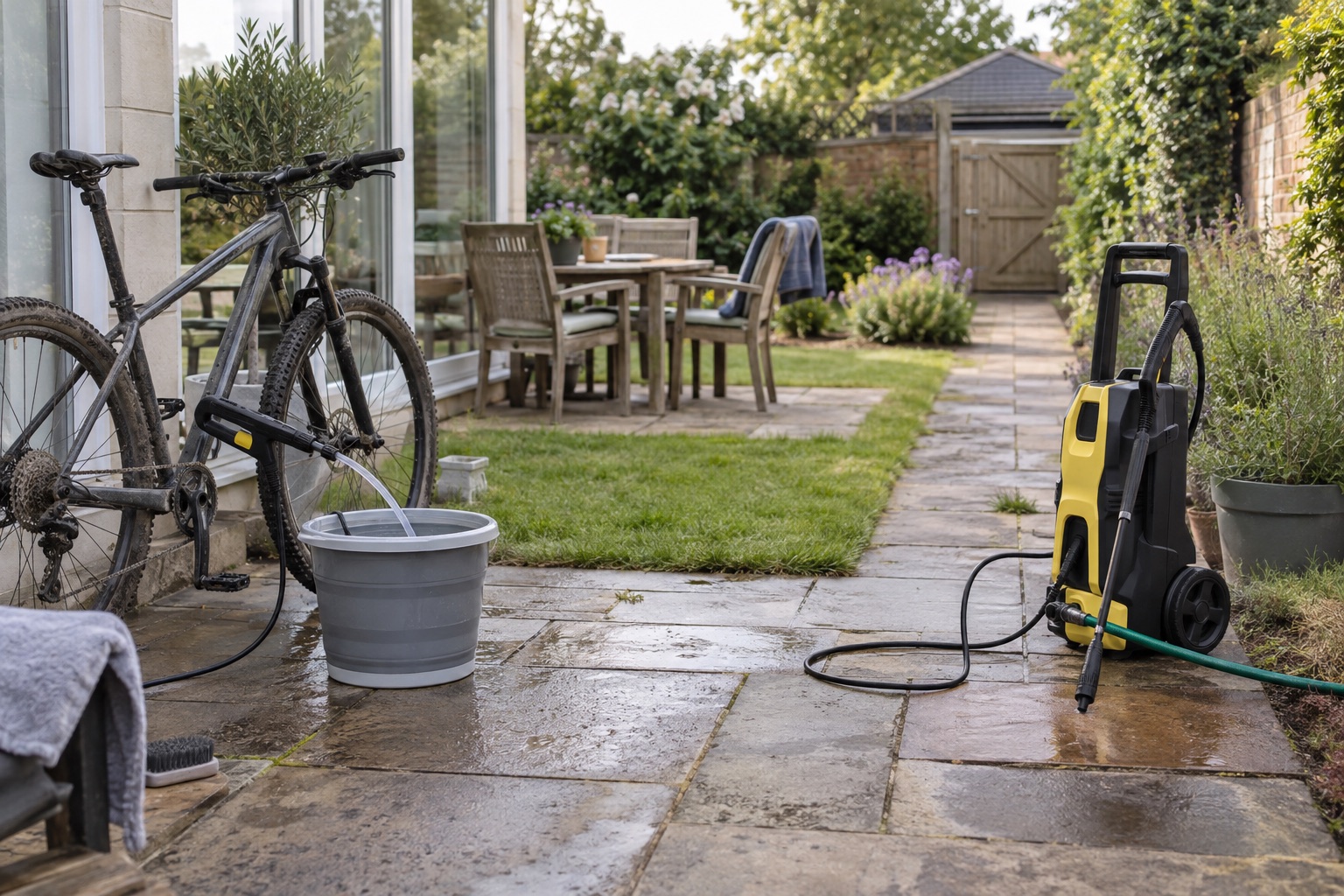
Worx specifies a bucket-capable suction hose and battery supply for the WG633E. Those setup details explain its portability more clearly than a pressure number alone. See Worx's WG633E specification.
Plain-English distinction
The difference is sustained cleaning ability
A power cleaner is a portable lower-output tool intended for rinsing and light dirt. A pressure washer uses a pump, continuous water supply and usually mains electricity to deliver much greater pressure and flow. Retailers sometimes use the terms loosely, so the specification matters more than the heading.
In practical terms, a power cleaner can be ready quickly beside a bicycle. A pressure washer takes more setup but clears a patio far faster. Neither format makes every surface safe: distance, nozzle and material condition remain decisive.
| Feature | Portable power cleaner | Domestic pressure washer |
|---|---|---|
| Primary purpose | Controlled portable rinsing | Faster cleaning and rinsing across larger areas |
| Typical supply | Battery plus bucket or tank | Mains electricity plus tap |
| Output in this catalogue | 20–56 bar max and up to 220 l/h | 120–140 bar max and 390–465 l/h |
| Storage | Small tool or wheeled tank unit | Compact body or trolley plus hoses |
| Best fit | Cars; bikes; furniture; muddy kit | Patios; driveways; paths; mixed household work |
Portable power cleaners
Best when water and storage access are limited
The Worx HydroShot is a handheld example with a filtered suction hose and five spray patterns. The Bosch Fontus is a wheeled alternative with a 15-litre built-in tank. They reduce connection problems but trade away the flow and continuous energy of mains equipment.
 View product on Amazon
Worx Nitro HydroShot WG633E
Best for: Bikes, garden furniture and quick rinses where portability matters most
A lightweight handheld cleaner rather than a substitute for a mains patio machine. It draws from a bucket or other fresh-water source and delivers 38-bar rated pressure with up to 220 l/h flow.
What stands out
- 2.2 kg with battery
- Draws from a separate water source
- Five spray patterns and 6 m suction hose
Keep in mind
- Far lower pressure and flow than a mains washer
- A poor fit for large or heavily soiled paving
- 38 bar rated
- 56 bar max
- 220 l/h max
- 20 V battery
 View product on Amazon
Bosch Fontus 18V
Best for: Cars, bikes and furniture where a tap or socket is inconvenient
A wheeled cordless outdoor cleaner with a 15-litre built-in tank, adjustable output and four spray patterns. Its 20-bar pressure suits controlled rinsing rather than large-patio restoration.
What stands out
- 15-litre built-in water tank
- Four spray patterns
- Up to 60 minutes quoted with the recommended battery
Keep in mind
- The selected Amazon listing excludes battery and charger
- 20 bar is not intended for heavy paved-area cleaning
- 20 bar max
- 15 l tank
- 4 m hose
- 18 V battery
Domestic pressure washers
Best when area and repeated cleaning matter
The Bosch UniversalAquatak 135 and Nilfisk Core 140 illustrate the compact mains class. Their much higher flow makes rinsing broad paving practical. They need a suitable tap connection, protected electricity, more storage and a route that keeps hoses under control.
 View product on Amazon
Bosch UniversalAquatak 135
Best for: Smaller homes wanting one compact machine with a multi-pattern nozzle
A compact 135-bar washer with a strong 450 l/h maximum flow and a practical three-in-one nozzle. It reduces attachment swapping for routine car, furniture and small-patio jobs.
What stands out
- 450 l/h maximum flow
- Three spray patterns in one nozzle
- 7.9 kg machine weight
Keep in mind
- No surface cleaner in the standard box
- The 7 m PVC hose is shorter and less flexible than some rivals
- 135 bar max
- 450 l/h
- 7 m hose
- Mains · 1.9 kW
 View product on Amazon
Nilfisk Core 140 PowerControl
Best for: Users who value in-hand adjustment and a lighter trolley format
A light trolley-format washer with power adjustment for mixed-garden jobs. The current Amazon page conflicts on supplied hose length, so confirm the exact bundle before buying it for reach.
What stands out
- Power adjustment
- Compact trolley format
- Useful mid-range output
Keep in mind
- Bundles differ between retailers
- A surface cleaner may still be an extra purchase
- 140 bar max
- 40 m²/h listed
- Confirm hose length
- Mains · 1.8 kW
Which tool fits each job?
Cars and bikes: both formats work when used carefully. A power cleaner is convenient and its lower output is easier to control, but it may rinse foam and heavy dirt more slowly.
Garden furniture and bins: a portable cleaner is often enough. Check the material and keep contaminated runoff away from drains.
Patios and driveways: a mains pressure washer is normally the correct class. Start with a broad fan and test an inconspicuous area before considering a rotary nozzle or surface cleaner.
Travel and flats: a handheld cleaner is easier to transport, but carrying clean water and managing wastewater can still be the limiting problem.
Specifications that cut through confusing product names
- Rated and maximum pressure: identify which figure describes normal working output.
- Flow: litres per hour reveal how quickly loosened dirt can be moved.
- Water source: integrated tank, suction hose or continuous tap supply.
- Power source: check whether batteries and chargers are actually included.
- Complete reach: distinguish a high-pressure hose from a suction or supply hose.
For a closer buying decision, compare portable pressure washers or read whether a cordless cleaner can handle a patio.
Frequently asked questions
Is a power cleaner the same as a pressure washer?
No. A power cleaner normally has much lower pressure and flow and prioritises portability. Retail naming varies, so verify the figures.
Can a power cleaner clean a patio?
It may lift light dirt from a small sound area, but a full patio is slow and established growth may remain. A mains washer is usually more suitable.
Is lower pressure better for bicycles?
Lower controlled output helps, but technique still matters. Keep the spray away from bearings, seals, suspension components and electrical connections.
Does a power cleaner need a tap?
Some draw from a bucket and others use an integrated tank. Follow the exact product instructions and use clean filtered water.
Which tool is better for a car?
A power cleaner suits an access-limited rinse. A controllable mains washer completes a full wash faster where tap and power connections are available.